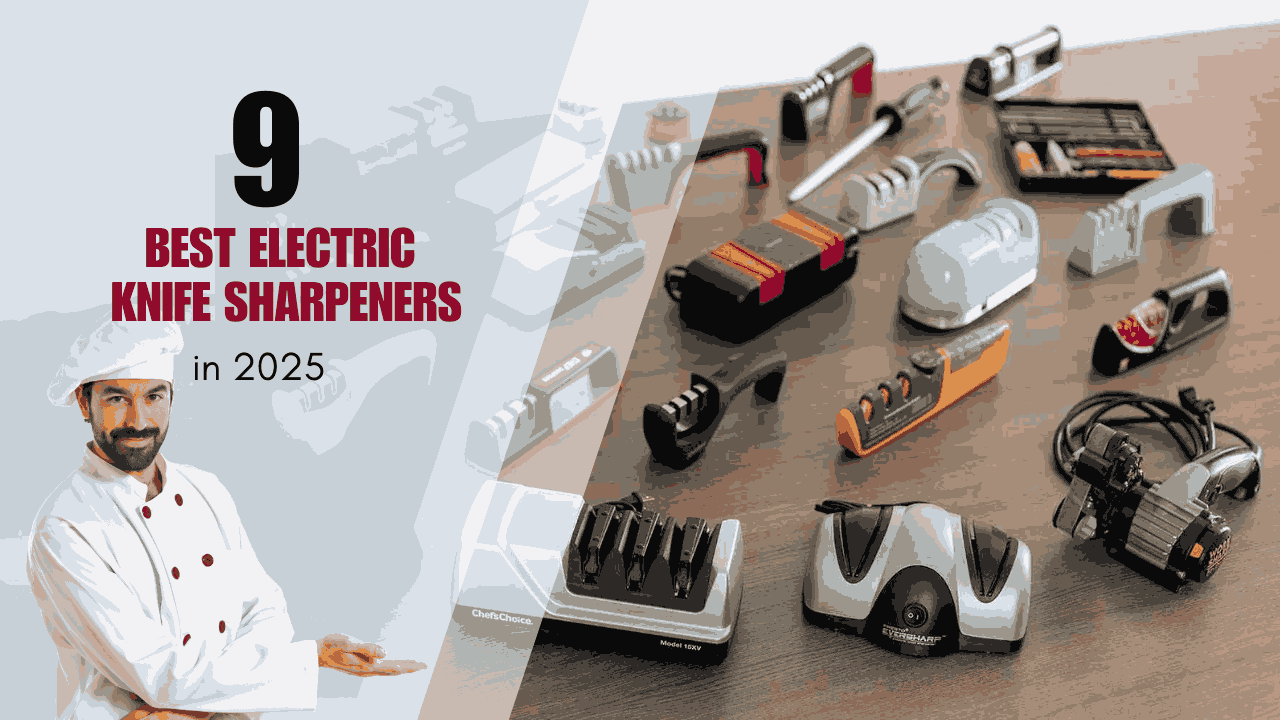
A dull kitchen knife can make simple prep slow, frustrating, and less safe. A sharp blade cuts with less force and gives you better control when slicing meat, vegetables, and other foods.
Electric knife sharpeners make sharpening faster and easier than many manual methods. They can help restore a dull edge with less skill and effort, but the results can vary a lot between models. Some are better for everyday kitchen knives, while others offer more control for different blade types and angles.
With so many options available, choosing the right electric sharpener can be hard. That’s why we evaluated 50 knife sharpeners and selected the 9 best electric models for 2026. We looked at sharpening performance, edge consistency, ease of use, blade compatibility, and overall value.
Whether you need a simple sharpener for everyday cooking or a more versatile model for different knives, this guide will help you compare your options and choose the right one for your kitchen.
Our Top picks of Best Electric Knife Sharpeners
Best Overall: Chef’sChoice 1520 Professional Electric Knife Sharpener
Best Value: Presto EverSharp Electric Knife Sharpener
Most Versatile: Work Sharp Ken Onion Edition Elite Mk.2
Best Compact: Narcissus Knife Sharpener
Best for Quick Sharpening: Homly Professional Electric Knife Sharpener
Best for Global Use: Northmas Professional Electric Knife Sharpener
Best for Beginners: VIDOME Professional Electric Knife Sharpener
Best for Multi-Purpose Use: Surudoisharp Pro Electric Knife Sharpener
Best for 15° Precision Sharpening: Chef’sChoice 15 Trizor XV
What We Looked For
We did not judge these electric knife sharpeners by price alone. We looked at how well they sharpened, how easy they were to use, and how well they held up during use. We also checked key features that matter in a home kitchen.
- Ease of use: We favored models with simple controls and clear guides. A good electric knife sharpener should not need a lot of skill to use.
- Edge consistency: We looked for a smooth, even edge from the heel to the tip. A sharpener should give steady results, not a sharp spot here and a dull spot there.
- Sharpening speed: We checked how fast each model could restore a dull knife. Fast is useful, but not if it hurts the edge or removes too much steel.
- Sharpening angles: We checked the edge angles each model could support. Models that handle both 15° and 20° edges can work well for different kitchen knives.
- Blade type: We checked which models could sharpen straight and serrated blades. We also looked at blade size and shape when it affected use.
- Build quality: We checked the body, guides, controls, and base. A good sharpener should feel stable and solid while you work.
- Noise: Electric sharpeners can be loud. We paid attention to the noise during use, since this matters in a home kitchen.
- Safety: We looked for stable bases, secure guides, and designs that keep your hands away from the sharpening parts. Easy and safe use was important.
- Extra features: We looked at useful features such as dust control, auto shutoff, and replaceable abrasives. These features only helped when they added real value.
- Value: We compared each sharpener’s results, features, build, and price. A higher price does not always mean better sharpening.
If You Sweetable Rolling knife harpener, Read Our Guide: 7 Best Rolling Knife Sharpeners in 2026
Best Overall: Chef’sChoice 1520 Electric Knife Sharpener
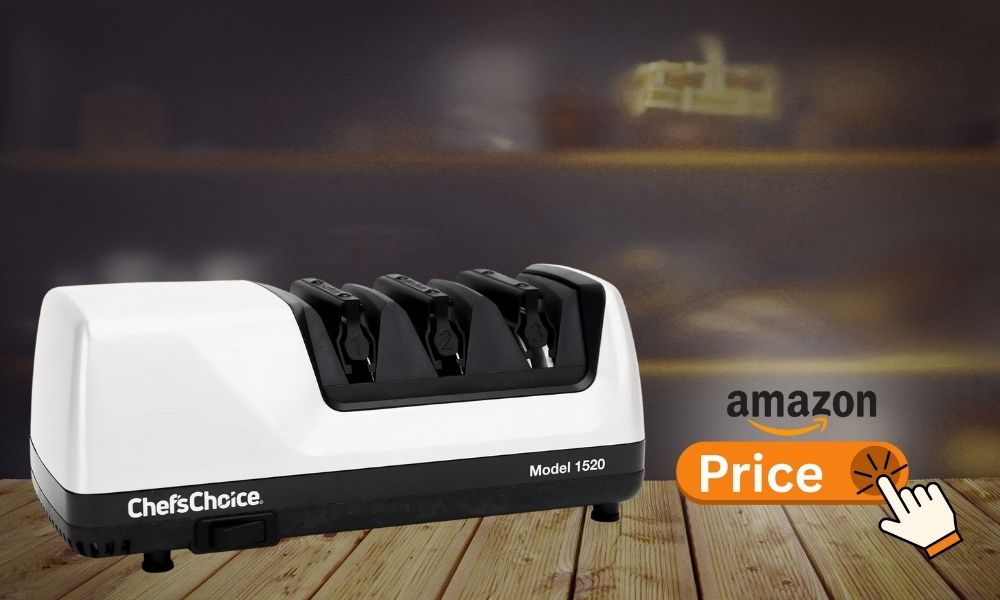
The Chef’sChoice 1520 is our best overall electric knife sharpener because it can sharpen both 15° and 20° knives. Its three-stage system is easy to use and gives a sharp, smooth edge without much effort.
After evaluating more than 50 knife sharpeners, we found the 1520 to be one of the most capable models for everyday kitchen use. We tested it on a dulled Henckels chef’s knife and checked the edge before and after sharpening. The sharpened knife sliced paper with ease, cut carrots cleanly, and sliced tomatoes without crushing them.
The 1520 stands out for its two-angle design. It supports 15° Asian-style knives and 20° Western-style knives, so you can sharpen different types of kitchen blades with one machine.
Its three stages use diamond abrasives for sharpening and honing, followed by a polishing stage. This helps create a sharp edge with a smooth finish. The controls are simple, so you do not need much sharpening skill to get started.
There are a few downsides. The 1520 is larger than many basic electric sharpeners, so it needs more counter space. It also makes noticeable noise while running.
Still, if you want one electric sharpener that can handle both 15° and 20° kitchen knives, the Chef’sChoice 1520 is a strong all-around choice.
What we like:
- Sharpens both 15° and 20° knife edges
- Three-stage system for sharpening, honing, and polishing
- Simple design that is easy to use
- Works well for everyday kitchen knives
- Produces a sharp and smooth cutting edge
What we don’t like:
- Takes up more counter space than compact models
- Noticeable operating noise
Best Value: Presto EverSharp Electric Knife Sharpener
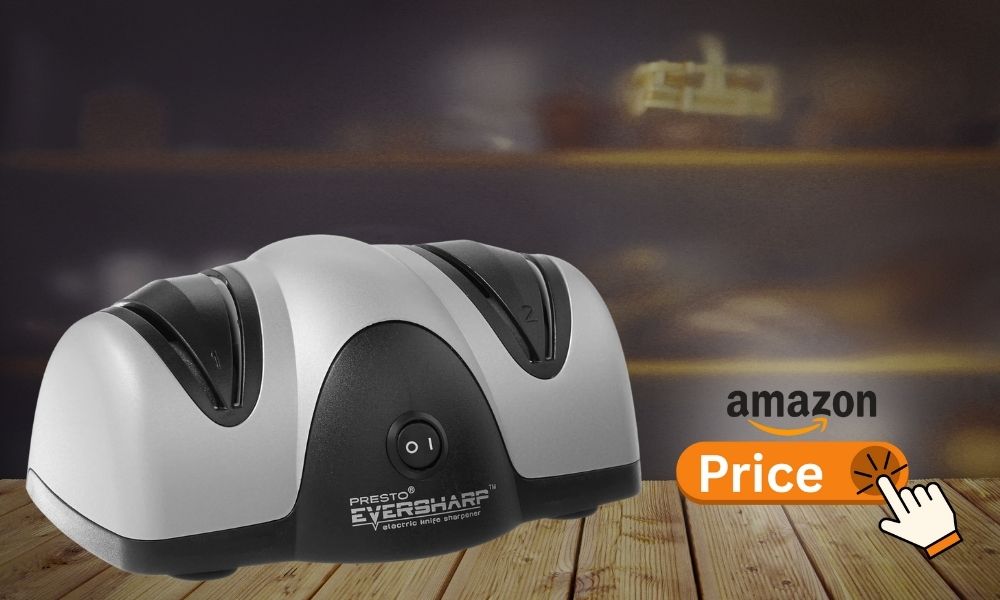
The Presto EverSharp is our best-value electric knife sharpener for cooks who want a simple way to sharpen everyday kitchen knives without spending much. It offers a quick two-stage sharpening process and is easy to use, even if you have never used an electric sharpener before.
During our evaluation, we used the EverSharp on a dull chef’s knife and checked its performance before and after sharpening. The sharpened knife sliced paper with ease and cut through carrots and tomatoes cleanly during practical kitchen tests.
The EverSharp uses a two-stage sharpening system with Sapphirite grinding wheels. The first stage sharpens the blade, while the second stage helps refine the edge. The process is quick, and the fixed guides make it easy to keep the knife in the right position.
The low price does come with some limits. The EverSharp can remove more metal from a blade than some higher-end sharpeners, so frequent sharpening may shorten the life of a knife over time. It also has limited flexibility for knives with unusual edge angles or specialty blade designs.
For basic kitchen knives, though, the EverSharp gives you a simple and low-cost way to restore a dull edge. If you want easy sharpening at a budget price, it is a practical choice.
What we like:
- Affordable price for everyday kitchen use
- Quick two-stage sharpening system
- Simple guides make it easy for beginners
- Sapphirite grinding wheels provide effective sharpening
- Good fit for common kitchen knives
What we don’t like:
- Can remove more blade material than some premium models
- Limited flexibility for unusual edge angles
- Not the best choice for specialty knives
Most Versatile: Work Sharp Ken Onion Edition Elite Mk.2

Most Versatile: Work Sharp Ken Onion Edition Elite Mk.2
The Work Sharp Ken Onion Edition Elite Mk.2 is our most versatile pick for anyone who wants more control over how a knife is sharpened. Unlike simple pull-through electric sharpeners, it gives you adjustable angles, variable speed, and a flexible belt system that can handle a wide range of blades.
During our evaluation, we used the Mk.2 on different types of knives and checked how well it handled common sharpening tasks. Sharpened blades performed well in practical tests, including slicing paper, cutting vegetables, and preparing meat.
One of its biggest strengths is its adjustable sharpening angle from 15° to 30°. This wide range lets you work with many kitchen, outdoor, and utility knives. The variable speed control also gives you more control over the sharpening process, which can be useful when working with different blade types.
The flexible abrasive belt is another key feature. It can sharpen, hone, and refine an edge while following the shape of the blade. With the right technique, it can also create a convex edge that offers good edge support and durability.
There is a trade-off for all this control. The Mk.2 costs more than a basic electric sharpener, and it takes time to learn how to use a belt system properly. Beginners may need some practice before they can get consistent results.
For experienced home cooks, knife enthusiasts, and anyone who sharpens more than just standard kitchen knives, the Mk.2 offers a level of control that simpler electric sharpeners cannot match.
What we like:
- Adjustable 15° to 30° sharpening range
- Variable speed gives you better control
- Flexible belt system handles many blade types
- Can sharpen, hone, and refine knife edges
- Useful for kitchen, outdoor, and utility knives
What we don’t like:
- Costs more than basic electric sharpeners
- Takes practice to use the belt system well
- More hands-on than a simple pull-through sharpener
Best Compact: Narcissus Knife Sharpener
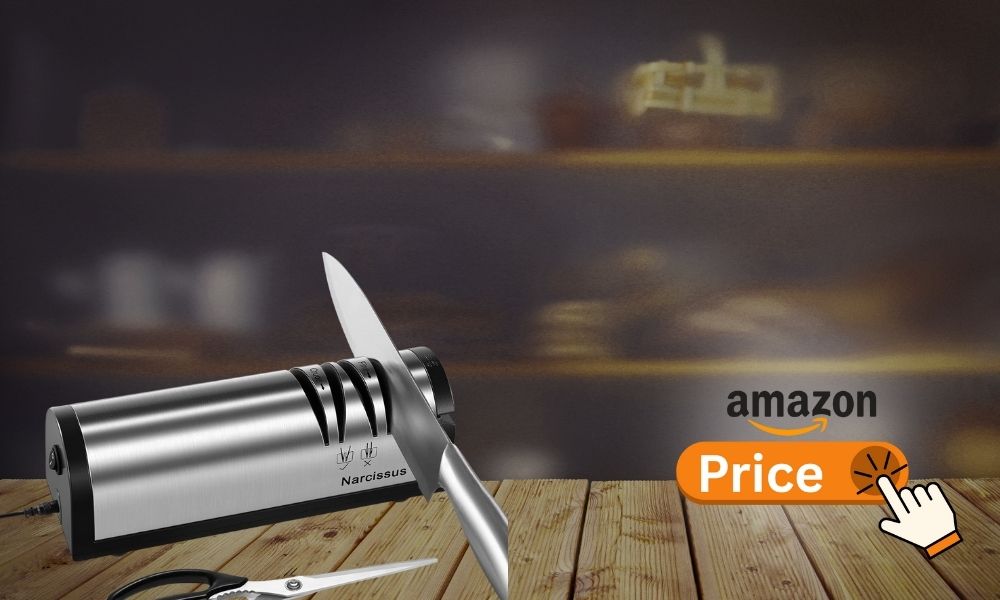
The Narcissus Knife Sharpener is our compact pick for kitchens where counter space is limited. Its small design takes up less room than larger electric sharpeners, while its two-stage system gives you a simple way to maintain everyday kitchen knives.
During our evaluation, the Narcissus improved the sharpness of a dull kitchen knife and handled basic slicing and chopping tasks after sharpening. The results were acceptable for everyday use, although the edge was not as consistent as what we saw from some higher-end models.
The sharpener uses a two-stage system with diamond abrasives for sharpening and honing. Its simple design makes it easy to use, and its small footprint is a real benefit if you have a small counter or limited storage space.
There are some limits to keep in mind. We noticed less consistent sharpening results during testing, and there were concerns about how aggressively it could affect the blade. Because of this, we would be more comfortable using it on standard everyday knives than on expensive or specialty blades.
If space is your main concern and you only need a basic sharpener for common kitchen knives, the Narcissus is worth considering. But if you own high-end knives or want very consistent edge control, a more advanced model may be a better fit.
What we like:
- Compact design works well in small kitchens
- Simple two-stage sharpening system
- Diamond abrasives for sharpening and honing
- Easy to use for basic kitchen knives
- Takes up little counter space
What we don’t like:
- Sharpening results can be less consistent
- May be too aggressive for some blades
- Not our first choice for expensive or specialty knives
Best for Quick Sharpening: Homly Professional Electric Knife Sharpener
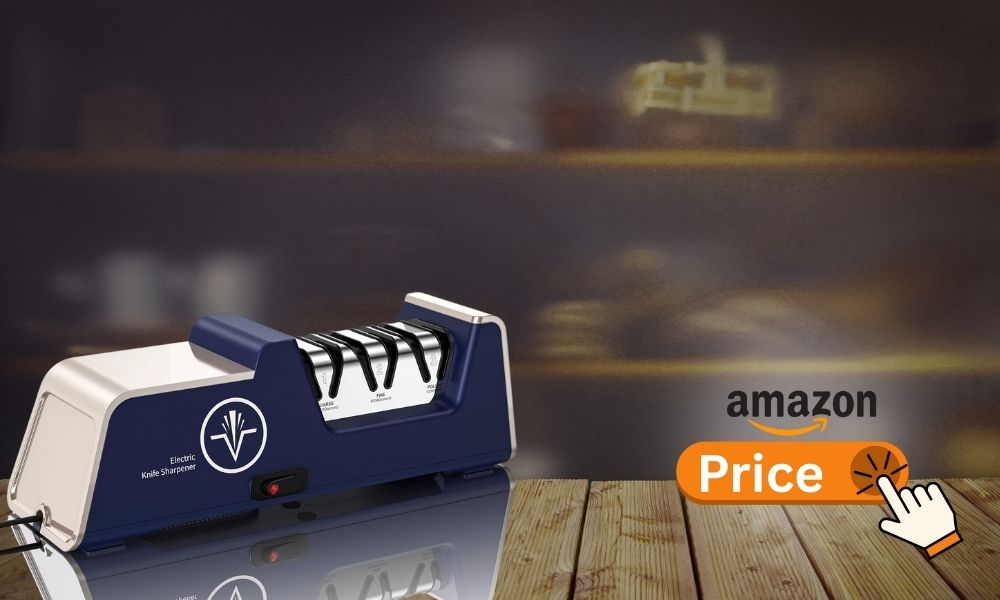
The Homly Professional Electric Knife Sharpener is our pick for fast sharpening. It is designed for quick touch-ups, and during our evaluation, it restored a dull Henckels chef’s knife in under a minute.
Before sharpening, the knife struggled to slice paper and cut carrots cleanly. After using the Homly, it sliced through tomatoes with much less effort and handled basic kitchen tasks with ease. This makes it useful when you need to bring a dull everyday knife back into working shape without spending much time on it.
The Homly uses a two-stage sharpening system for sharpening and polishing. Its diamond abrasives work quickly, while the compact body is easy to store when you are done. The light weight also makes it easy to move around the kitchen.
The fast sharpening does come with some limits. During our testing, we found that it could be too aggressive on softer steel, so it is worth using with care on knives that have a softer blade. It also does not support serrated knives.
For quick maintenance on standard kitchen knives, the Homly is a practical budget option. If your main goal is fast sharpening with simple operation, this model is worth considering.
What we like:
- Can sharpen a dull knife in under a minute
- Compact and lightweight design
- Simple two-stage sharpening system
- Diamond abrasives provide fast sharpening
- Easy to use for everyday kitchen knives
What we don’t like:
- Can be too aggressive on softer steel
- Does not sharpen serrated knives
- Less suitable for specialty blades
Best for Global Use: Northmas Professional Electric Knife Sharpener
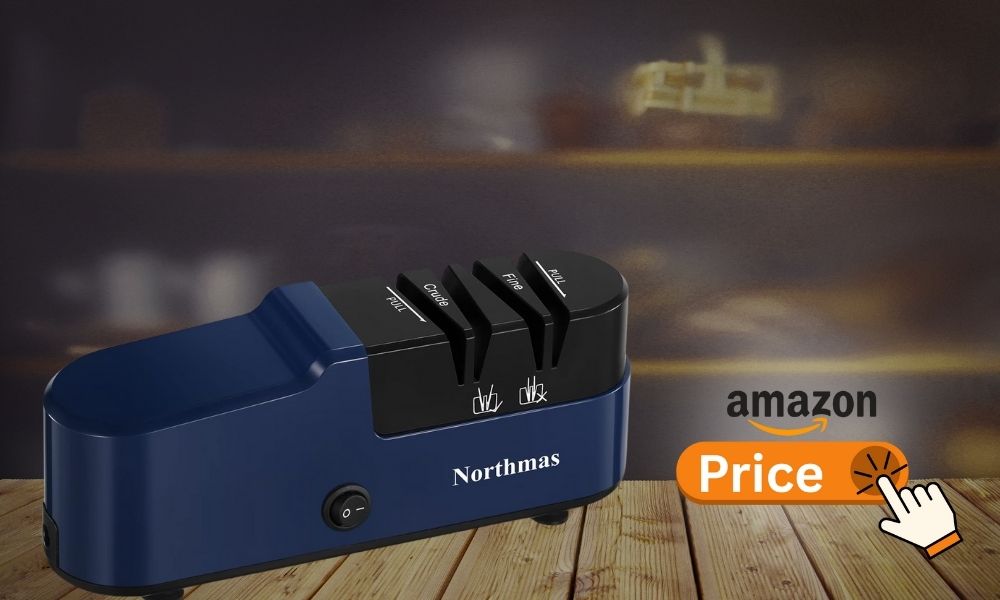
Best for 15° and 20° Knives: Northmas Professional Electric Knife Sharpener
The Northmas Professional Electric Knife Sharpener is a useful choice if you own both Western and Asian-style kitchen knives. Its dual-angle design supports 15° and 20° edges, giving you more flexibility than a sharpener made for one edge angle.
During our evaluation, we used the Northmas with both 15° and 20° knives to check how well it handled different blade styles. We also sharpened a dull Henckels chef’s knife and tested the edge in practical kitchen tasks. After sharpening, the knife sliced paper cleanly and made smoother, more controlled cuts through tomatoes.
The Northmas has a solid design with non-slip feet that help keep the unit stable during use. Its layout is simple to understand, and the built-in cooling fan helps manage heat during repeated sharpening sessions.
There are a couple of drawbacks. The motor is louder than some other electric sharpeners we tested, and the polishing stage did not produce as refined a finish as some higher-end models. These are minor trade-offs if your main need is support for different knife angles.
If your kitchen has a mix of Western and Asian-style knives, the Northmas offers useful angle flexibility in a simple electric design. It is especially worth considering if you want one sharpener for both 15° and 20° edges.
What we like:
- Supports both 15° and 20° knife angles
- Works with Western and Asian-style kitchen knives
- Solid body with non-slip feet
- Built-in cooling fan helps manage heat
- Simple layout and easy operation
What we don’t like:
- Louder than some competing models
- Polishing stage could produce a smoother finish
Best for Beginners: VIDOME Professional Electric Knife Sharpener
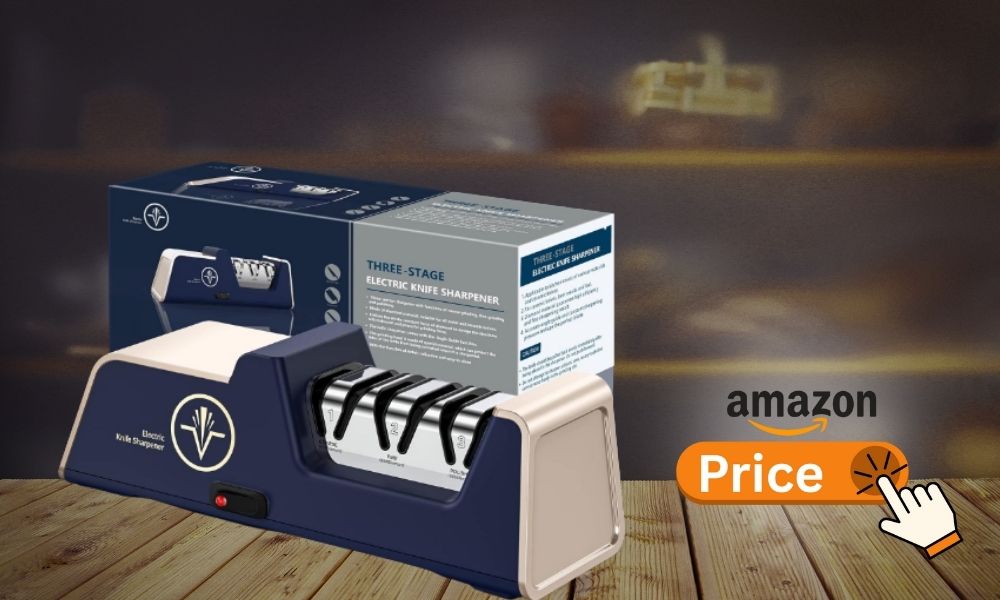
Best for Beginners: VIDOME Professional Electric Knife Sharpener
The VIDOME Professional Electric Knife Sharpener is our pick for beginners because it keeps the sharpening process simple. The built-in guides help position the knife, so new users do not need to learn how to hold a sharpening stone or control an angle by hand.
During our evaluation, we used the VIDOME to restore a dull Henckels chef’s knife. The sharpened knife passed our paper test and sliced tomatoes with less pressure than before. The simple setup makes it easy to use for routine kitchen sharpening.
The VIDOME uses a two-stage sharpening system with guided slots that help keep the blade in position. Its compact body also takes up little counter space. Rubber feet help keep the sharpener stable while you work.
However, it does not offer the same level of edge control as more advanced models. We would also avoid using it as the main sharpener for expensive Japanese knives unless the knife and its edge angle are confirmed to be compatible with the machine.
For a first electric sharpener, the VIDOME is easy to understand and requires little practice. If you want a simple way to maintain standard kitchen knives without learning manual sharpening techniques, it is a practical option.
What we like:
- Very easy for beginners to use
- Guided sharpening slots help with blade positioning
- Compact design saves counter space
- Rubber feet help keep the unit stable
- Requires little sharpening experience
What we don’t like:
- Less control than more advanced sharpeners
- Not the best choice for some premium or specialty knives
- Limited flexibility for users who want to control the sharpening angle
Best for Multi-Purpose: Surudoisharp Pro Electric Knife Sharpener
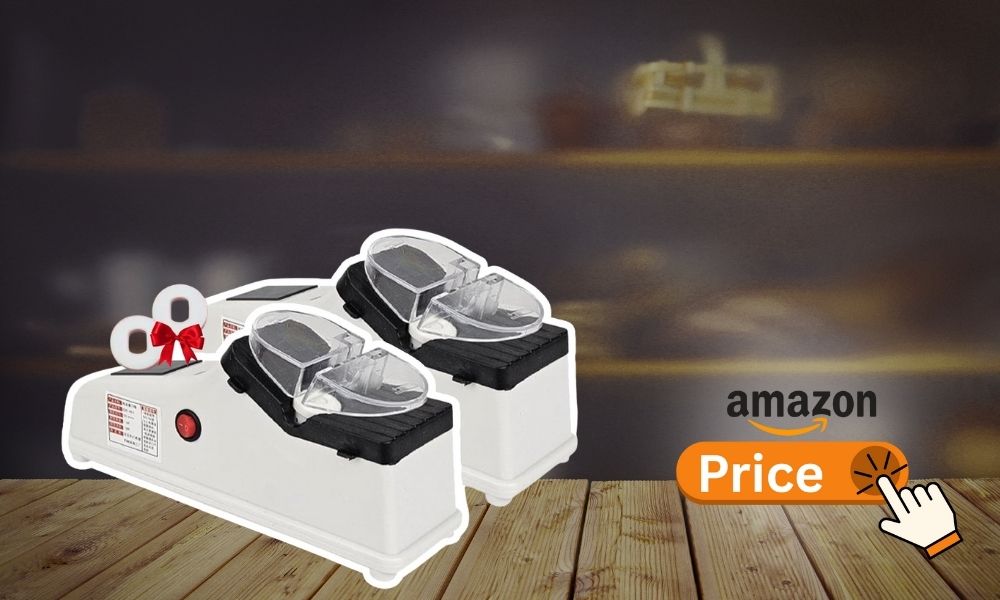
Best for Multi-Purpose Use: Surudoisharp Pro Electric Knife Sharpener
The Surudoisharp Pro Electric Knife Sharpener is our pick for multi-purpose use because it can handle different knife types and offers adjustable sharpening angles. It is a good fit for home cooks who own more than just a standard chef’s knife.
During our evaluation, we tested the Surudoisharp Pro with several blade types, including serrated and carving knives. We also used it on a dull Henckels chef’s knife and checked the edge after sharpening. In practical kitchen tests, the sharpened knife made clean cuts through tomatoes, carrots, and bread.
The sharpener uses a three-stage system with coarse, medium, and fine sharpening stages. An adjustable angle dial lets you change the sharpening angle to suit different blades. This gives you more control than a fixed-angle sharpener.
Its wider range of settings also makes the Surudoisharp Pro useful for different sharpening jobs. However, that extra control means there is a small learning curve. The unit is also larger than many compact electric sharpeners, so it needs more storage or counter space.
If you want one electric sharpener for different knife types and sharpening needs, the Surudoisharp Pro offers useful flexibility. It is better suited to users who do not mind spending a little time learning the settings.
What we like:
- Supports multiple knife types, including serrated blades
- Adjustable angle dial gives you more control
- Three sharpening stages for different levels of sharpening
- Useful for a wider range of kitchen knives
- Handles sharpening, refining, and finishing in one unit
What we don’t like:
- Takes some practice to learn the settings
- Larger than many basic electric sharpeners
- More controls than a simple beginner model
Best for 15° Edges: Chef’sChoice 15 Trizor XV Electric Knife Sharpener
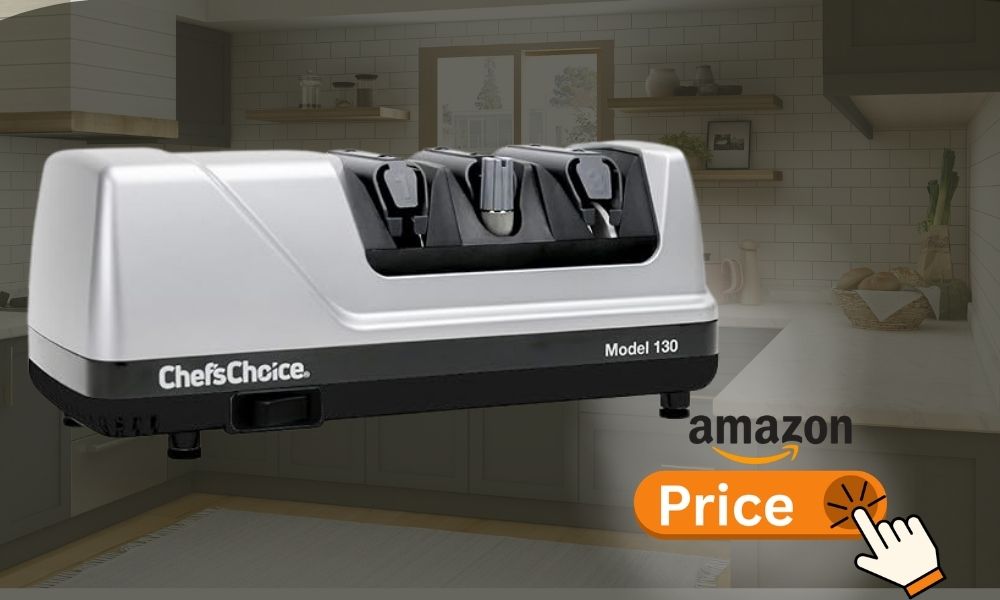
The Chef’sChoice 15 Trizor XV is a strong choice if you want to sharpen kitchen knives to a 15° edge. Its three-stage system is built to convert standard 20° knife edges to a sharper 15° edge, making it especially useful for cooks who want a fine cutting edge on compatible kitchen knives.
During our evaluation, we used the Trizor XV on a dull chef’s knife and checked its performance before and after sharpening. The sharpened knife handled common kitchen tasks with less effort, including slicing paper, cutting carrots, and making clean cuts through tomatoes.
The Trizor XV uses three sharpening stages. Diamond abrasives reshape the edge in the first stages, while the final stage hones and polishes it. The guided slots help keep the blade at the correct angle, so you do not need to control the angle by hand.
One thing to keep in mind is that the Trizor XV is designed around a 15° edge, so it is not as flexible as the Chef’sChoice 1520, which supports both 15° and 20° edges. It is also more focused on kitchen knives than sharpeners designed for a wider range of tools.
If you prefer the cutting feel of a 15° kitchen-knife edge and want an electric sharpener that is simple to use, the Trizor XV is worth considering. It is a more focused option than the 1520 rather than a replacement for it.
What we like:
- Creates a 15° edge for compatible kitchen knives
- Three-stage sharpening, honing, and polishing system
- Diamond abrasives help reshape dull edges
- Guided slots make the sharpening process simple
- Good fit for cooks who prefer a fine 15° edge
What we don’t like:
- Less flexible than models that support both 15° and 20° edges
- More focused on kitchen knives than general-purpose sharpening
- Not ideal if you need to maintain several different edge angles
Electric Knife Sharpener vs Manual Sharpener
Choosing between an electric and manual knife sharpener comes down to how much speed, control, and effort you want. Electric models are faster and easier for most beginners, while manual methods give you more control over the sharpening process.
Electric Knife Sharpeners
Electric sharpeners are built for speed and convenience. Most models use guided sharpening slots, so you can sharpen a knife without having to learn how to hold a precise angle by hand.
They are a good fit for busy home cooks who want to restore a dull knife with less time and effort. Many models can also sharpen different edge angles, depending on the design.
The trade-off is that electric sharpeners can remove more metal than careful manual sharpening. You also have less control over the exact shape and angle of the edge.
Manual Knife Sharpeners
Manual sharpening methods include whetstones and guided sharpening systems. They take more time and practice, but they give you greater control over the sharpening angle, pressure, and amount of metal removed.
With a whetstone, you can create and maintain a custom edge based on the knife and the way you use it. A guided system can make this process easier by helping you maintain a set angle.
Manual sharpeners are often more affordable than premium electric models, and they can be a good choice if you want maximum control over your knives. The main downside is the learning curve. Getting consistent results takes practice and patience.
Which One Should You Choose?
Choose an electric knife sharpener if you want fast, simple sharpening with less hands-on work. Choose a manual sharpener if you want more control and do not mind spending time learning the technique.
Neither option is best for every knife or every cook. The right choice depends on your knife type, sharpening experience, budget, and how much control you want over the final edge.
Still Confused ? See Our Full Breakdown: Knife Sharpener vs Whetstone To Be More Clear
How to Choose an Electric Knife Sharpener
Choosing an electric knife sharpener is easier when you know what to check. The right model should match your knife type, edge angle, sharpening needs, and budget.
Here are the key factors to consider before you buy.
1. Sharpening Angle Compatibility
Check the edge angle your knives use before choosing a sharpener. Many Western kitchen knives use an edge around 20° per side, while many Asian-style knives use a finer 15° per side edge.
If you own both types, look for a sharpener that supports both angles. The Chef’sChoice 1520, for example, is designed to handle both 15° and 20° edges.
2. Abrasive Type and Quality
The abrasive does the actual work of removing metal and shaping the edge. Common options include diamond, ceramic, and other abrasive materials, and each can behave differently.
Diamond abrasives are useful for quickly sharpening hard steel, but the quality and design of the abrasive matter as much as the material itself. A sharpener that removes metal too aggressively can wear a knife faster with frequent use.
3. Number of Sharpening Stages
Many electric sharpeners use two or three stages. A coarse stage can reshape a dull or damaged edge, while finer stages refine and polish the edge.
More stages do not always mean better results. What matters is whether the stages fit your sharpening needs and produce a clean, consistent edge.
4. Knife Compatibility
Check which knives the sharpener can handle before buying. Some models are made mainly for standard straight-edge kitchen knives, while others can also work with serrated knives, thicker blades, or different knife sizes.
Do not assume that an electric sharpener can safely sharpen every knife. Always check the manufacturer’s blade and angle requirements, especially for specialty or high-end knives.
5. Ease of Use
If you are new to sharpening, look for guided slots, clear controls, and a stable base. These features can make it easier to position the knife correctly.
More advanced users may prefer adjustable angles and speed controls. These settings offer more control but can also take more practice to use well.
6. Safety and Stability
A good electric sharpener should stay firmly in place while you use it. Look for non-slip feet, stable knife guides, and controls that are easy to reach.
Also check how the knife enters the sharpening slot. A well-designed guide can help you keep your fingers away from the abrasive parts while sharpening.
7. Noise and Vibration
Electric sharpeners use motors, so some noise is normal. However, excessive vibration can make the knife harder to control and can make the sharpening process less comfortable.
If you plan to use your sharpener often, noise level and stability are worth considering along with sharpening performance.
8. Speed and Sharpening Frequency
If you sharpen knives often, look for a model that can restore an edge quickly without removing more metal than needed. Fast sharpening is useful for busy kitchens, but speed should not be the only factor.
For occasional touch-ups, a slower model may still be a good choice if it gives you better control and consistent results.
9. Price vs. Performance
Do not choose a sharpener based on price alone. Compare its sharpening performance, blade compatibility, build quality, controls, and long-term usefulness.
A budget model such as the Presto EverSharp can make sense for basic kitchen knives. A higher-priced model may be worth considering if you need adjustable angles, more sharpening stages, or greater control.
10. Consider the Knives You Already Own
The best electric sharpener is the one that matches your knives. Before buying, check their edge angle, blade type, steel, and manufacturer’s sharpening advice.
If you own a mix of standard, Asian-style, serrated, or specialty knives, choose a model that clearly supports those blade types. This can prevent you from buying a sharpener that works well but is not suitable for your knife collection.
Final Verdict
Final Verdict
The right electric knife sharpener depends on your knives, sharpening needs, and budget. Some models focus on speed and simplicity, while others give you more control over edge angles and different blade types.
For an all-around option, the Chef’sChoice 1520 stands out for its support for both 15° and 20° knife edges. If price is your main concern, the Presto EverSharp offers a simple two-stage system for everyday kitchen knives.
If you want more control, the Work Sharp Ken Onion Edition Elite Mk.2 gives you adjustable angles and variable speed. For a small kitchen, the Narcissus takes up less counter space, while the Homly is a useful option when fast sharpening is your main goal.
The Northmas is worth considering if you use both 15° and 20° knives. The VIDOME keeps things simple for beginners, while the Surudoisharp Pro offers more flexibility for different knife types. If you specifically want a 15° edge, the Chef’sChoice 15 Trizor XV is the more focused choice.
Before you buy, check your knives’ edge angles and blade types first. The best sharpener for you is not always the most expensive model—it is the one that fits your knives and gives you the level of control and convenience you need.
Why Trust Cutting Resource?
At Cutting Resource, we focus on how kitchen tools perform in real use—not just what the product page promises. Our reviews combine hands-on evaluation, practical kitchen tests, product research, and clear buying advice to help you choose tools that fit your needs.
For this guide, we evaluated 50 knife sharpeners, including electric, manual, and rolling models. We looked at sharpening performance, edge consistency, ease of use, blade compatibility, build quality, and value.
Where measurement tools were used, we used an Edge-On-Up Professional Edge Tester to check knife sharpness before and after sharpening. We also used practical tests such as slicing paper, cutting carrots, and slicing tomatoes to see how the sharpened edge performed during common kitchen tasks.
We did not judge a sharpener by sharpness alone. We also considered how easy it was to use, how stable it felt during sharpening, how much control it offered, and whether its features matched its price.
Our goal is simple: give you clear, practical, and honest information about electric knife sharpeners. We explain both the strengths and the limits of each model so you can choose a sharpener based on your own knives, skill level, and budget.
FAQ
What is the best electric knife sharpener on the market?
The Chef’sChoice 1520 AngleSelect is widely regarded as the best overall electric knife sharpener. It sharpens both 15° and 20° knives, works fast, and produces razor-sharp results with minimal effort.
What is the absolute best knife sharpener?
For versatility, precision, and long-term value, the Work Sharp Ken Onion Elite Mk.2 stands out. It’s highly customizable and handles everything from chef’s knives to hunting blades.
What electric knife sharpener does America’s Test Kitchen recommend?
America’s Test Kitchen has repeatedly recommended the Chef’sChoice 15 Trizor XV for its consistent results, speed, and ease of use across a wide range of blades.
What’s the difference between an electric knife sharpener and a whetstone?
An electric sharpener automates the sharpening process, offering speed and consistency. A whetstone requires manual control but offers greater precision and is gentler on high-end knives.
Is it better to use an electric knife sharpener or a whetstone?
Electric sharpeners are faster and more user-friendly. Whetstones offer greater control and are better for delicate or premium blades.
Can you use an electric knife sharpener on any type of knife?
Most electric sharpeners handle straight-edge and serrated knives. Some also support Asian-style and 15° knives. Always check compatibility first.
Which is better: electric knife sharpener or manual sharpener?
It depends on your needs. Electric sharpeners deliver speed, consistency, and ease—ideal for busy cooks. Meanwhile, manual sharpeners offer more control and preserve blade life, making them great for high-end knives and precision work.
What is the est Electric Knife Sharpener for Beginners
Chef’sChoice 1520 AngleSelect Professional Electric Knife Sharpener.


