Buy a 12-inch stainless skillet first. Add a nonstick pan in the $30 range for eggs. That pair covers nearly everything a home cook makes, and together they cost less than one All-Clad D5 skillet.
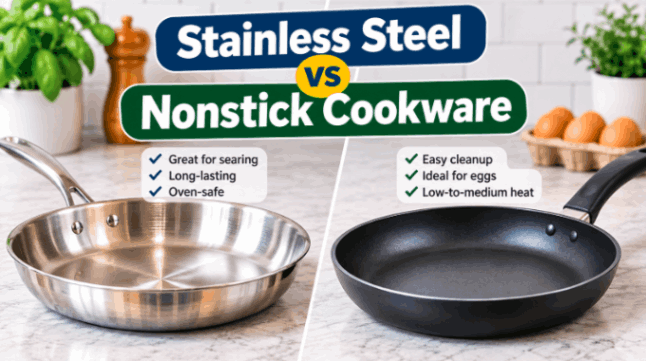
In the stainless steel vs nonstick cookware choice, stainless wins at searing, pan sauces, oven work and lifespan. Nonstick wins at eggs, delicate fish and quick cleanup, but it has the lower heat ceiling: about 500°F before the coating breaks down. Most home cooks do best with both, and stainless is the better first purchase.
Key takeaways
- Sear, brown and make pan sauces in stainless steel. Use nonstick for eggs, flaky fish and pancakes.
- Never preheat an empty nonstick pan or take it past 500°F. Stainless needs 2 to 4 minutes of preheating on medium.
- In Food Network’s 2026 tests, a Tramontina 12-inch tri-ply cost about $50, Made In $149 and All-Clad D5 $200. Nonstick pans run from under $10 to about $60.
- Independent sources put nonstick life at 1 to 5 years. The industry says 5 to 7. No standard test settles it.
- Minnesota, Colorado and Maine already restrict PFAS in cookware. Connecticut and Vermont follow in 2028.
- Stainless leaches trace nickel and chromium, mostly in long tomato simmers. Nickel-free 18/0 steel avoids the nickel.
Stainless steel vs nonstick cookware: what to use for each dish
Match the pan to the food and most of this debate settles itself. Browning needs bare, hot metal. Delicate proteins need a surface that lets go.
| Dish | Better pan | Why |
| Fried or scrambled eggs | Nonstick | Releases at medium-low heat with little fat |
| Steak, pork chops, chicken thighs | Stainless steel | Direct metal contact builds a deep brown crust |
| Pan sauce after searing | Stainless steel | Stuck-on bits (fond) dissolve into the sauce |
| Pancakes and crepes | Nonstick | Flips cleanly at low heat |
| Flaky fish and fish skin | Nonstick, or stainless with skill | Delicate flesh tears when it grabs the pan |
| Pasta water, soup, stock | Stainless steel | Nonstick adds nothing and wears for no reason |
| Stovetop-to-oven finishes | Stainless steel | Higher oven ratings than most coatings |
Seared steak in a 12-inch stainless steel skillet beside a nonstick pan holding a fried egg
That split is why cooks keep landing on the same answer in the stainless steel vs nonstick cookware argument. On cooking forums, a common setup is stainless for nearly everything and one inexpensive nonstick pan kept only for eggs. It works because each pan covers the other’s weak spot. The sections below cover technique, safety, cost and the order to buy in.
Why stainless steel wins at searing and pan sauces
A good crust is a contact problem. The food has to touch hot metal long enough to brown, and a slick coating works against that, so meat on nonstick tends to steam in its own juices instead. Stainless gives the sear something to grab.
That grip also builds fond, the browned film left on the pan after searing. Pour in a splash of wine or stock, scrape, and the pan sauce is half done. On nonstick the fond barely forms, so there’s nothing to dissolve.
Construction matters as much as the material. Look for fully clad pans, where an aluminum core runs from rim to rim between steel layers. America’s Test Kitchen’s Lisa McManus makes the same recommendation. Tri-ply (three layers) is the usual standard, and five-ply adds layers and cost.
Stainless also moves from burner to oven. Most clad pans are rated to at least 500°F, though lids and handles can have lower limits. Makers rate PTFE pans between 400°F and 500°F, and nonstick should never go under a broiler. For high-heat work, the stainless steel vs nonstick cookware contest has a clear winner.
Nonstick vs stainless steel pans for eggs, fish and fast cleanup
Here nonstick wins, and it isn’t close. In a Consumer Reports survey of 2,158 U.S. adults, 59% of nonstick users named easy cleanup as a reason they chose it.
An omelet slides out at medium-low heat with a teaspoon of butter. A stainless pan can do the same, and plenty of cooks do it daily, but scrambled eggs and thin crepes punish a few seconds of bad timing. Delicate fillets like sole tear if they grab the pan. Forum threads show the pattern: people who love their steel skillets often keep one cheap pan just for eggs.
My position: if eggs and pancakes are your weekday cooking, buy the nonstick pan first. An 8 or 10-inch size is plenty for eggs. If it’s your only nonstick pan, America’s Test Kitchen recommends 12 inches, which fits a frittata for six.
Keep the heat at medium or below. Use silicone, nylon or wood. And plan on replacing it, a cost the breakdown later in this guide covers.
How to stop food from sticking to stainless steel
Sticking is a heat problem. Proteins bond to cold or underheated steel, and a short routine prevents it.
- Pat the food dry and let it sit out for a few minutes. Cold, wet food drops the pan’s temperature on contact.
- Heat the empty pan on medium for 2 to 4 minutes. Higher heat doesn’t speed things up and scorches the oil.
- Flick in a few drops of water. When they bead up and skate around like mercury, the pan has reached the Leidenfrost point. If they sizzle and vanish, wait another minute.
- Wipe out the water, add your oil, and let it shimmer.
- Add the food and leave it alone. A properly seared piece releases on its own. If it tugs, give it a little longer.
Water droplets beading on a preheated stainless steel pan during the Leidenfrost water test
Sources disagree on the exact surface temperature, from about 365°F in America’s Test Kitchen’s explanation to 420°F in other tests. Trust the water drop over any number. Don’t crowd the pan either, since extra food cools the surface and breaks the effect.
Fried eggs work with this method. Scrambled eggs remain the hardest case, which is why the nonstick egg pan survives in so many kitchens. That’s the practical heart of stainless steel vs nonstick cookware for beginners. how to make stainless steel nonstick
Is nonstick cookware safe? Heat, scratches and PFAS
Used at low to medium heat and replaced when it scratches, a PTFE pan is a low risk. That’s my read, and the evidence below is why I’d stop short of calling it harmless. In the stainless steel vs nonstick cookware debate, this is where the arguments get loudest.
Heat
The documented hazard is overheating. PTFE coatings break down above about 500°F, and the fumes can cause polymer fume fever: chills, fever and headache. U.S. poison centers have logged more than 3,600 suspected cases over two decades, typically from a pan left heating unattended. Pet birds are far more sensitive and can die from the same fumes. Never preheat an empty nonstick pan.
Scratches
A 2022 lab study from Flinders University and the University of Newcastle estimated that one crack can release about 9,100 plastic particles, and a badly broken coating up to 2.3 million, during simulated cooking. Health effects remain unconfirmed, and the researchers asked for more study. Consumer Reports’ advice is blunt: toss a chipped or scratched pan.
PFAS claims
PTFE is itself a PFAS. The related chemical PFOA was phased out in the U.S. between 2014 and 2015, yet a “PFOA-free” label proves little. Consumer Reports found PFAS in a PTFE pan sold with that claim, which its distributor disputed, and CR now suggests shopping for PTFE-free pans if you want to avoid them. On the other side, an Emory environmental health professor told Live Science that nonstick pans are generally not dangerous. Consumer Reports PFAS-free nonstick testing best PFAS-free nonstick pans
Is stainless steel safe? Nickel, chromium and grades
For most people, yes. On safety, stainless steel vs nonstick cookware both come out low risk, with one caveat for anyone with a nickel allergy.
Stainless steel leaches trace nickel and chromium, mostly from new pans and long acidic simmers. In a 2013 study in the Journal of Agricultural and Food Chemistry, nickel in tomato sauce rose up to 26-fold and chromium up to 7-fold after six hours, depending on the steel grade. Six hours of tomato sauce in a brand-new pan is a worst case, and leaching tends to fall as a pan ages and cook times shorten.
A 2016 Italian study of grade 316 (18/10) pots concluded they were safe for most people with nickel or chromium allergy under ordinary cooking. Highly sensitive people can still react.
| Grade | Nickel | Best for | Catch |
| 18/10 | 10% | Most home cooks | Leaches a little nickel and chromium |
| 18/8 | 8% | Same use, close to 18/10 | Same trace leaching |
| 18/0 | None | Nickel allergy | Corrodes more easily |
If you’re allergic, buy 18/0 or switch to carbon steel. Everyone else can stop worrying, with one habit: don’t park a long tomato braise in a pan that’s only weeks old.
PFAS cookware laws in the US: what changes for your pan
Several states now restrict PFAS in cookware, and the rules fall on retailers, so PTFE pans are thinning out on shelves in some places.
- Minnesota: first in the country, effective January 2025.
- Colorado and Maine: bans began January 2026.
- Connecticut: ban starts in 2028, and a PFAS labeling law took effect July 1, 2026.
- Vermont: pushed its ban back to 2028.
- Rhode Island: has passed a ban as well.
- California: the governor vetoed SB 682 on October 13, 2025, citing the cost of affordable cookware, though state law already requires certain PFAS disclosures.
- New York: lawmakers have introduced a bill targeting PTFE cookware.
The laws target “intentionally added” PFAS, which puts PTFE nonstick in scope and leaves stainless steel out. Industry groups argue PTFE is safe and note the FDA has authorized it for food contact since the 1960s. A Maine nonprofit reviewed more than 200 cookware brands in 2026 and found most pulled products from the state quickly.
Dates shift and lawsuits are pending, including industry’s challenge to New Mexico’s labeling mandate. For anyone weighing stainless steel vs nonstick cookware in one of these states, the choice may narrow before you shop. Check your state’s rules first. state PFAS cookware rules tracker
Stainless steel vs nonstick cookware cost over 10 years
Sticker prices mislead. In Food Network’s 2026 tests, the Tramontina 12-inch tri-ply pan cost about $50 and carries a lifetime warranty, Made In’s 12-inch ran $149, and the All-Clad D5 12-inch cost $200. Nonstick pans run from under $10 to about $60.
Spread the cost over time and the picture changes. The lifespans below are my assumptions, not measured data.
| Pan | Price | Assumed life | Cost per year |
| Tramontina 12-inch tri-ply | $50 | 10 years | $5 |
| All-Clad D5 12-inch | $200 | 10 years | $20 |
| Mid-range nonstick | $30 | 3 years | $10 |
| Top-end nonstick | $60 | 5 years | $12 |
Bar chart comparing yearly cost of stainless steel and nonstick pans over 10 years
Real nonstick lifespans depend on who’s talking. Independent review sites say 1 to 5 years, Made In says 2 to 3, and the Cookware & Bakeware Alliance says 5 to 7 for quality coatings. No standard test produces any of those numbers. Consumer Reports scours coatings with a machine and publishes scores, with no lifespan figures. Serious Eats put it plainly: coatings wear, so don’t spend a lot on one.
Stainless has no coating to lose, so the realistic limit is damage. The $50 pan is the cheapest per year here. The $200 pan only matches nonstick’s yearly cost at about 20 years, so you’re paying for performance.
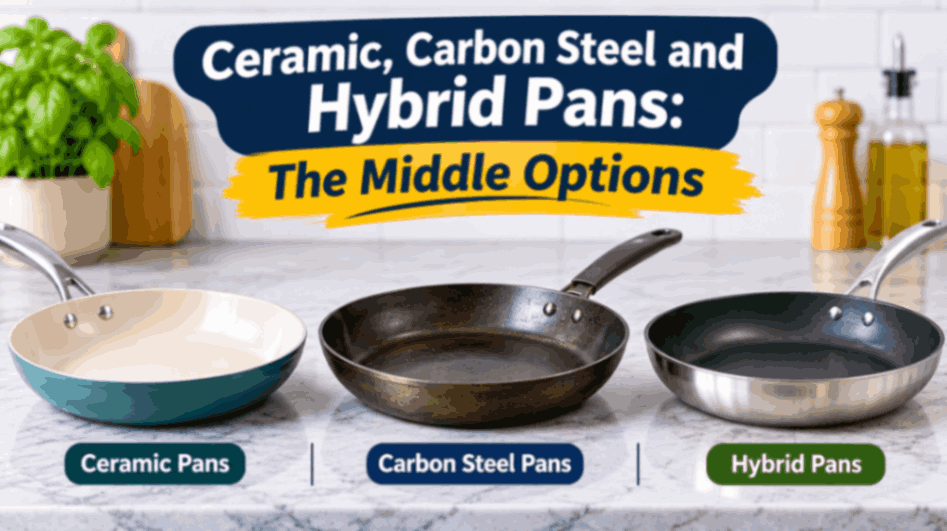
Ceramic, carbon steel and hybrid pans: the middle options
If neither pan fits, three alternatives keep coming up, and each changes the stainless steel vs nonstick cookware math in a different way.
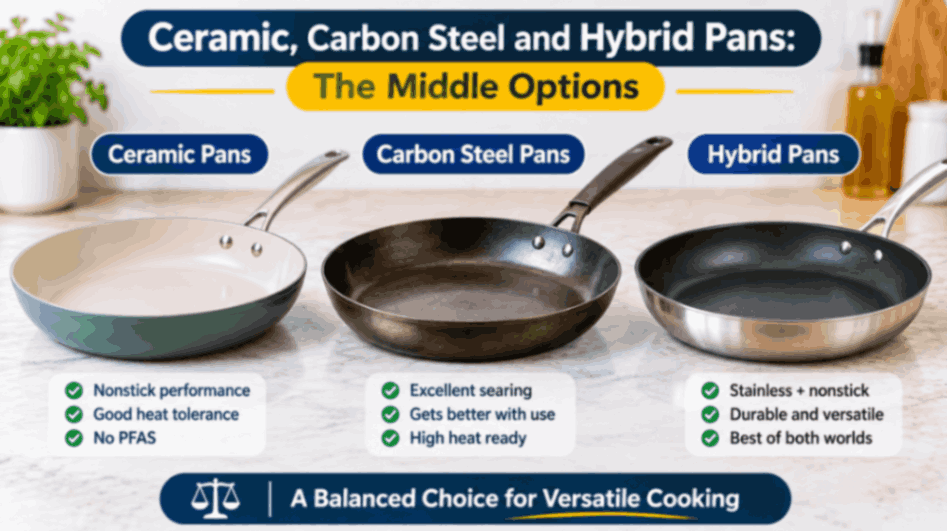
Ceramic nonstick
This is a sol-gel coating with no PTFE. Consumer Reports found none of 96 PFAS in the two ceramic pans it tested. The catch is life: Wirecutter’s testers found ceramic coatings lose their slickness sooner than PTFE, and one review site puts the average at about two years. ceramic vs stainless steel cookware
Carbon steel
Forum cooks call seasoned carbon steel more forgiving than stainless for eggs, and America’s Test Kitchen points people who want longevity toward carbon steel or cast iron. It needs seasoning, reacts with acidic foods, and rusts if left wet. That upkeep is the price.
Hybrid pans
Hybrids etch a steel grid over a nonstick coating. HexClad’s 2023 class action accused the brand of misleading “non-toxic” and “PFAS-free” claims while its pans used PTFE. It settled for $2.5 million, covering purchases from February 2022 to March 2024, and the company says its current coating is PTFE-free ceramic. The coating still wears. The lifetime warranty covers defects, and it says nothing about how long the slickness lasts.
Stainless vs nonstick pans on induction, in the oven and at the sink
A few specs decide daily use, and they matter more than brand in any stainless steel vs nonstick cookware comparison.
| Feature | Stainless steel | Nonstick |
| Induction | Works if the base is magnetic; 18/0 exteriors are | Depends on the base; many pans work, so check the label |
| Oven | Most clad pans rated 500°F or higher; check lids and handles | 400°F to 500°F depending on the pan; never under a broiler |
| Dishwasher | Fine for most | Skip it, even if labeled dishwasher-safe |
| Utensils | Metal works, though it can leave marks | Silicone, nylon or wood only |
| Cleaning | Soak while warm and deglaze stuck bits | Cool completely first, then hand wash |
Test induction compatibility with a refrigerator magnet. If it grips the base firmly, the pan will work on an induction cooktop. For nonstick, Consumer Reports adds one more rule: let the pan cool fully before it touches water.
Which pan to buy first
Your habits decide the order.
Buy stainless first if you sear, roast or make pan sauces
Food Network’s 2026 tests picked Made In’s 12-inch ($149) as best overall, the Tramontina 12-inch tri-ply (about 50)asbestvalue,andtheAll-CladD512-inch(200) as best high-end. For a first pan, the Tramontina gives up little. Tramontina 12-Inch Tri-Ply Clad Fry Pan
Buy nonstick first if eggs, pancakes and fast mornings dominate
Choose a 10-inch pan in the $30 range, expect 1 to 5 years, and replace it at the first scratch. If you want to avoid PFAS, pick a PTFE-free ceramic pan or carbon steel instead. 10-inch nonstick skillet
Buy both if you cook most days
Pair a 12-inch stainless skillet with an 8 or 10-inch nonstick. That’s about $80 at the low end, less than one All-Clad D5. A large cookware set saves money only if you’ll use every piece.
A tri-ply stainless steel skillet and a ceramic nonstick pan side by side on a stovetop
Frequently asked questions
Is stainless steel safer than nonstick?
Stainless has no coating to overheat or flake, so it sidesteps PTFE and PFAS questions. Its own issue is trace nickel and chromium, which matters mainly for nickel allergy or very long acidic simmers. Used correctly, both are low risk for most people.
Can you cook eggs on stainless steel without sticking?
Yes. Preheat on medium for 2 to 4 minutes, confirm with the water drop test, add fat, then the eggs. Fried eggs behave well this way. Scrambled eggs are least forgiving, so many cooks keep a nonstick pan for them.
How often should you replace nonstick pans?
Replace at the first chip, deep scratch or when eggs start sticking. That works out to 1 to 5 years for most pans. The industry’s 5 to 7 year figure is the optimistic end.
Is it okay to use a scratched nonstick pan?
Consumer Reports says to throw it out. Some food-safety writers argue swallowed flakes won’t make you ill, though the pan will stick more. With replacements around $30, swapping it is the simple way to skip the argument.
Is ceramic nonstick better than Teflon?
Ceramic avoids PTFE, and Consumer Reports found no PFAS in the two ceramic pans it tested. The trade is lifespan, since ceramic coatings lose their slickness sooner. Choose it if avoiding PFAS matters more than longevity.
Do stainless steel and nonstick pans work on induction?
Both can, if the base is magnetic. Most tri-ply stainless pans are sold as induction-ready, and nickel-free 18/0 exteriors are magnetic. For nonstick, check the label for an induction symbol or test the base with a magnet.
Summary: stainless steel vs nonstick cookware, decided
The stainless steel vs nonstick cookware decision comes down to seven points.
- Task: Sear, roast and make pan sauces in a 12-inch tri-ply stainless pan, which costs $50 to $200. Cook eggs, crepes and fish in a 10-inch nonstick pan around $30.
- Heat: Never preheat an empty nonstick pan or take it past 500°F. Stainless wants 2 to 4 minutes on medium and a water drop test.
- Safety: Both are low risk when used correctly. PTFE carries open questions on scratches and PFAS. Stainless carries a nickel question that matters mainly for allergy, where 18/0 steel solves it.
- Cost: Under my assumptions, stainless runs $5 to $20 a year and nonstick $10 to $12. Nonstick lifespans are unmeasured, with claims from 1 to 7 years.
- Law: Minnesota, Colorado and Maine restrict PFAS in cookware now, with Connecticut and Vermont in 2028. Check your state before buying PTFE.
- Middle options: Ceramic avoids PTFE but wears faster. Carbon steel is forgiving for eggs but needs seasoning. Hybrids carry a recent false-advertising settlement.
- Order: Buy one pan this month, stainless if you cook dinners and nonstick if you cook breakfasts. Buy the second when the first one frustrates you.