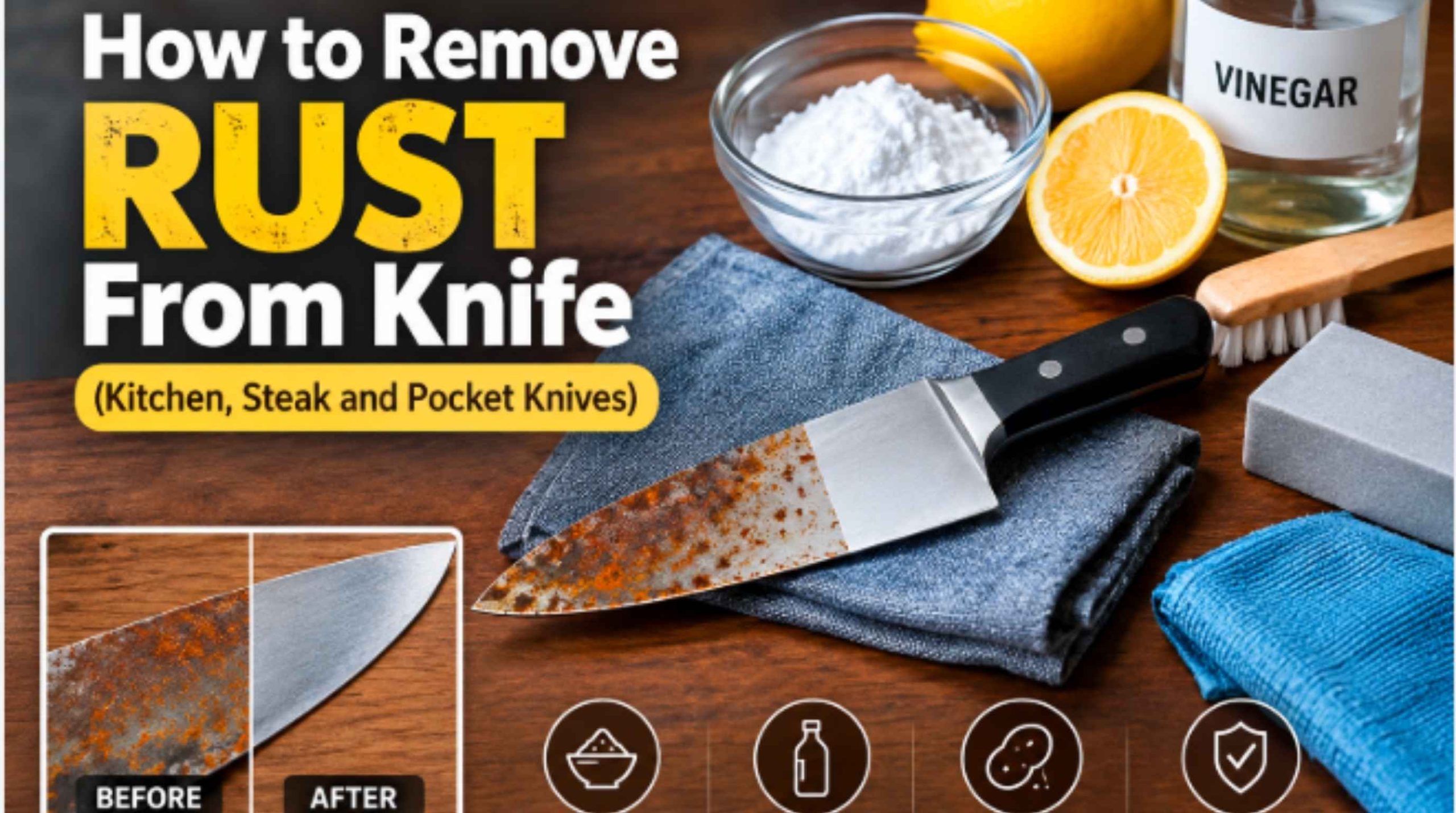
Rust on knives is more than just an eyesore—it can ruin a good blade and even make cutting unsafe. I remember the first time I saw rust spots on my favorite chef’s knife. I panicked, thinking I had to throw it away. But after some research (and a few mistakes), I learned how to remove rust from a knife easily.
In this guide, you will learn how to remove rust from knife using 4 simple easy methods, including baking soda, vinegar, and even a potato trick! You’ll also learn how to prevent rust from coming back and find the best rust-resistant knives to buy. Whether it’s a kitchen knife, pocket knife, or stainless steel blade, I’ve got you covered.
Learning how to remove rust from a knife can save you time and money. This guide covers everything you need to know about effective rust removal.
But let’s make sure we are on the same page?
Why is Rust Removing Important?
Knowing how to remove rust from a knife ensures it stays safe for food preparation.
One popular method to remove rust from a knife involves using baking soda.Rust damages knives over time. It weakens the metal, making the knife brittle. If left unchecked, rust can ruin a good knife completely. Also, rust is not safe for food preparation.
It can mix with your food and change the taste. Removing rust keeps your knives strong, clean, and safe to use. Plus, a well-maintained knife lasts longer, saving you money in the long run.
How to Remove Rust From Knife
Start with a baking soda paste and a soft brush. If the spots stay, switch to a rust eraser used along the grain of the blade, and keep acids like vinegar or Bar Keepers Friend to a few minutes. The order matters, because each step up in strength takes a little more steel off along with the rust.
I panicked the first time I found rust on my favorite chef’s knife and nearly threw it out. I didn’t need to. Most rust comes off, and the method you pick decides whether the blade survives the cleaning.
First, check that it’s rust
Rust is powdery and orange or red, and it rubs off on a fingernail. Patina doesn’t. It runs from golden yellow through blue and purple to gray on carbon steel, it stays put when you scrub, and it protects the blade. If your spots are patina, leave them alone.
Why knives rust in the first place
Stainless steel needs at least 10.5% chromium, which forms a thin oxide layer on the surface. That layer repairs itself, but only with oxygen around. A knife put away wet, or folded shut, or sealed in a sheath, can’t heal, and chloride in water and detergent attacks the weak spots. One knife retailer says the dishwasher is behind about 90% of the rusty stainless knives that come into its shop. That’s one shop’s count, not a study, but the chlorine in dishwasher detergent is a known culprit.
Carbon steel has no protective layer at all. Leave it wet and it rusts.
Method 1: Baking soda paste
Baking soda is a mild abrasive. It doesn’t dissolve rust, but fresh red rust is soft and loosely attached, so it often scrubs off.
- Mix baking soda with a little water into a thick paste.
- Spread it over the rust and leave it for 15 minutes.
- Scrub with a soft toothbrush or cloth.
- Rinse, then dry the knife completely.
It’s the safest first move on stainless and carbon steel alike. In one hobbyist test on a drill bit, it also beat vinegar, toothpaste and coffee. That was a single test on a non-knife, so take it as a hint.
Method 2: A rust eraser
This is the best-tested option on the list. Cook’s Illustrated tested rust erasers, which are rubber blocks loaded with a medium or fine abrasive, and picked a medium-grit Sabitoru eraser as the winner. Wet the knife and rub along the grain of the steel, not across it.
Two catches. Erasers scratch if you press hard, and they strip decorative finishes. One retailer warns that scrubbing too hard can remove the kurouchi finish on Japanese knives. If you see black marks where the rust was, that’s pitting, which I cover below.
Method 3: Bar Keepers Friend
Knife retailers recommend it for light rust. Wet the area, use a small amount, rub gently with a soft cloth along the grain, then rinse right away.
The active ingredient is oxalic acid, and the label itself says it may etch or dull delicate surfaces. It tells you to test a hidden spot first and to go extra gently on brushed finishes and magnetic stainless steel. One forum user says it etches steel when left on for more than about 60 seconds. That number is anecdotal, but “don’t let it sit” shows up in several places, so I treat it as a rule.
Method 4: White vinegar
Vinegar is the most argued-over method, and the soak times people give don’t agree. A tool hobbyist says 30 to 45 minutes for light rust and a couple of hours for heavy rust. A Japanese kitchen-knife retailer says 3 hours or overnight. An EDC knife-care site says never overnight, because vinegar can etch the steel and darken the finish.
I side with the short soak. Give it 30 to 45 minutes, check every 10, and stop as soon as the rust loosens. If the blade turns bluish-gray, that isn’t harmful, but it changes how the knife looks, so don’t use vinegar on a knife you want to keep pristine. Rinse well afterward.
Method 5: A chelating soak (Evapo-Rust type)
The maker says its chelator binds the iron in rust but is too weak to pull iron out of the steel itself. That makes it gentler than an acid for long soaks. It isn’t foolproof. One razor-restoration user reported a blade turning black after an overnight soak, and the maker blames carbon in high-carbon steel. Try it on a cheap knife before you trust it with a good one.
Lemon juice, salt and the potato trick
I found no testing of either one. Lemon juice is a mild acid, so treat it like vinegar: minutes, not hours, with a pinch of salt as a scrubbing grit if you like. The potato trick is slow and unproven. The sources that explain it can’t even agree on which acid is involved, which tells me the explanation was copied around rather than checked. It probably does no harm on a light spot. I wouldn’t rely on it.
Kitchen and steak knives
Most kitchen rust is light, so baking soda and a toothbrush usually do the job. Serrated bread knives are the awkward case, since an eraser can’t follow the teeth and the toothbrush can. Don’t soak knives with wood handles, because the wood swells and cracks. Rust marks on stainless knives and forks come off the same way.
Steak knives that live in the dishwasher usually get spotted at the tip first. Hand wash them from here on.
Pocket, folding and hunting knives
Open the knife fully and clean the pivot area with a toothbrush. For heavier rust, forum users spray WD-40 and work the spots with 0000 steel wool. Keep the spray off handle scales, since its solvents can damage some materials. Steel wool and wire brushes usually won’t scratch hardened cutlery steel, but a Scotch-Brite pad can change the finish, and brass bristles are safer still.
Handles need their own care. Wood scales get a gentle wipe with mineral oil and no soaking. G10 and micarta clean up with mild soap and water. WD-40 evaporates, so it’s a poor pivot lubricant. Use a proper knife oil there.
For a badly rusted vintage knife, electrolysis is worth a look. A knifemaker moderator on one forum calls it the best way to remove rust without hurting non-ferrous parts like brass or nickel silver. It takes more setup than a paste does.
Will sharpening remove rust?
On the edge, yes, because grinding removes metal and the rust goes with it. It does nothing for rust on the flats of the blade, and you lose steel you didn’t need to lose. Clean first, and sharpen only if the edge is still dull.
When the rust leaves pits
Cleaning removes the orange rust and can leave small dark pits behind. Those are permanent. One restorer still had considerable pitting after sanding and polishing, and ended up forcing a mustard patina on the blade to stabilize it. A pitted knife still cuts, but the pits catch moisture, so dry it with extra care and keep it oiled.
Finish: dry, then oil
Dry the knife fully before oiling, because oil laid over a damp blade traps the moisture against the steel. Mineral oil is the standard choice, since it doesn’t go rancid. Camellia oil is the traditional Japanese pick. I’ve dropped the old advice to use cooking oil, because most of it turns rancid and sticky.
Is a rusty knife dangerous?
A bit of rust on a clean knife won’t hurt you. A University of Illinois physics Q&A says iron oxide is benign in small amounts. A secondary source citing UC Berkeley adds a caveat for people with hemochromatosis, a condition that causes the body to store too much iron. Rust can make food taste off, so clean it anyway.
Tetanus is the other worry. McGill’s Office for Science and Society points out that a cut from a rusty object isn’t worse than a cut from a clean one, because the bacteria live in soil and animal digestive tracts, not in rust. If your skin gets pierced by any knife, check that your tetanus shot is current.
How to stop it coming back
- Dry the knife right after washing, every time.
- Leave knives out of the dishwasher.
- Don’t put a knife away wet, and don’t fold or sheathe it damp.
- Oil carbon steel after use.
- Make sure knives are dry before they go in a block or on a magnetic strip.
Knives that rust less
Stainless steel is the low-maintenance choice, though as you’ve seen, it still rusts under neglect. Ceramic knives don’t rust at all, but they chip and snap if you drop them or twist them in a cut.
Five stainless sets worth a look: Victorinox Swiss Classic 11-Piece, Wüsthof Gourmet 2-Piece with Block, Global 6-Piece Block Set, Cangshan S1 17-Piece, and Dalstrong Gladiator 8-Piece. None of them is rustproof. They just forgive a missed wipe more than carbon steel does.
FAQs
What’s the safest way to remove rust from a knife?
Baking soda paste and a soft brush. Rinse and dry afterward.
Can vinegar damage a knife?
Yes. Long soaks can etch the steel and darken the finish. Keep it to 30 to 45 minutes and check often.
Does lemon juice remove rust from stainless steel knives?
On light spots it can, with a few minutes of contact and a scrub. Rinse, dry, and oil right away.
Can I remove rust from an old knife?
Usually, yes. The rust comes off, but any pitting stays.
Is rust on a knife dangerous?
A small amount isn’t, but clean it off for taste. Rust doesn’t cause tetanus.
What is the safest way to remove rust from a knife?
The safest method is using baking soda. Mix it with water to form a paste, apply it to the rusted area, scrub gently with a toothbrush, let it sit for 15–20 minutes, then rinse and dry thoroughly.
Can vinegar damage a knife while removing rust?
White vinegar is effective for rust removal, especially on carbon steel knives. However, prolonged soaking can weaken the blade or affect the finish. Always rinse and oil the knife after treatment.
Does lemon juice remove rust from stainless steel knives?
Yes, lemon juice contains citric acid that dissolves rust. For better results, add salt before scrubbing. Rinse and dry the knife completely, then apply a thin coat of oil to prevent future rust.
Is rust on knives dangerous for food preparation?
Rust can harbor bacteria and alter the taste of food. While small spots may not be harmful, deeply rusted knives should be cleaned thoroughly before use to ensure safety.
How do I prevent rust from forming on my knives?
Keep knives dry, avoid dishwashers, apply mineral oil regularly, and store them in a dry place using a knife block or magnetic strip. Proper maintenance is key to rust prevention.
What are the best rust-proof knife sets to buy?
Top-rated rust-resistant knife sets include:
- Victorinox Swiss Classic 11-Piece Set
- Wüsthof Gourmet 2-Piece Set
- Global 6-Piece Block Set
- Cangshan S1 Series 17-Piece Set
- Dalstrong Gladiator Series 8-Piece Set
Can I use the potato trick to remove rust from knives?
Yes! Potatoes contain oxalic acid, which naturally breaks down rust. Insert the blade into a raw potato, let it sit for a few hours, then scrub and rinse. It’s ideal for light rust spots.
“`html “`