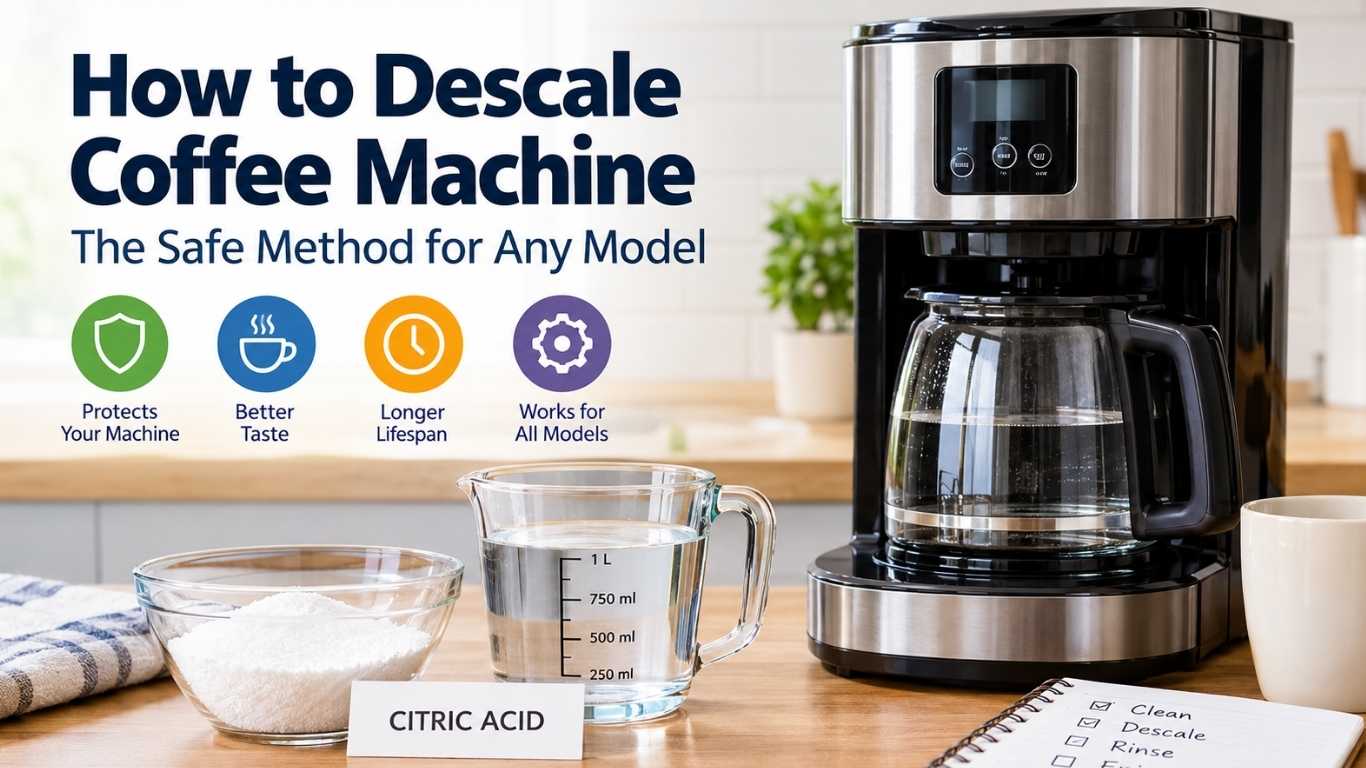
Dissolve about 15 grams of food-grade citric acid in a liter of warm water, run it through the machine, let it sit for 15 to 30 minutes, then rinse three times. That covers most drip makers. Pod and espresso machines add rules, and skipping them costs money.
If you’re working out how to descale coffee machine models without voiding a warranty, start with your manual’s descale mode, pick a descaler your brand allows, and rinse until the water has no taste or smell. Citric acid is the safest cheap option for most machines. Vinegar works on basic drip makers, but it starts arguments everywhere else.
Key takeaways
- Run the built-in descale mode first if your machine has one. Nespresso, Keurig, Breville and De’Longhi models track the cycle, and a rushed run leaves the descale light on.
- Citric acid costs roughly $0.50 to $1.00 per descale. De’Longhi’s branded liquid works out to about $4 a use at $19.95 for five doses.
- Published citric acid doses run from about 15 g to 40 g per liter. Start near 15 g/L, and stay at or under that on aluminum boilers.
- White vinegar is fine for a cheap drip maker. Retailers and reviewers flag Nespresso, Keurig and Jura machines as the ones to keep it away from.
- Rinse with at least three full tanks of fresh water, four if your water is hard.
- Descale your coffee machine every three months by default, monthly in very hard water, or every 40 brews on a Breville One-Touch CoffeeHouse if you use tap water.
How to descale coffee machine: check these three things first
Slow brewing, gurgling noises, less coffee per cycle, white flakes in the reservoir or a lit descale light all mean limescale has already built up. Before you mix anything, spend two minutes on the checks that decide everything else.
First, open the manual to the descaling page. Nespresso publishes model-specific steps on a support page, and Keurig, Breville and De’Longhi machines run a programmed cycle that tracks your rinses. Nespresso machine support
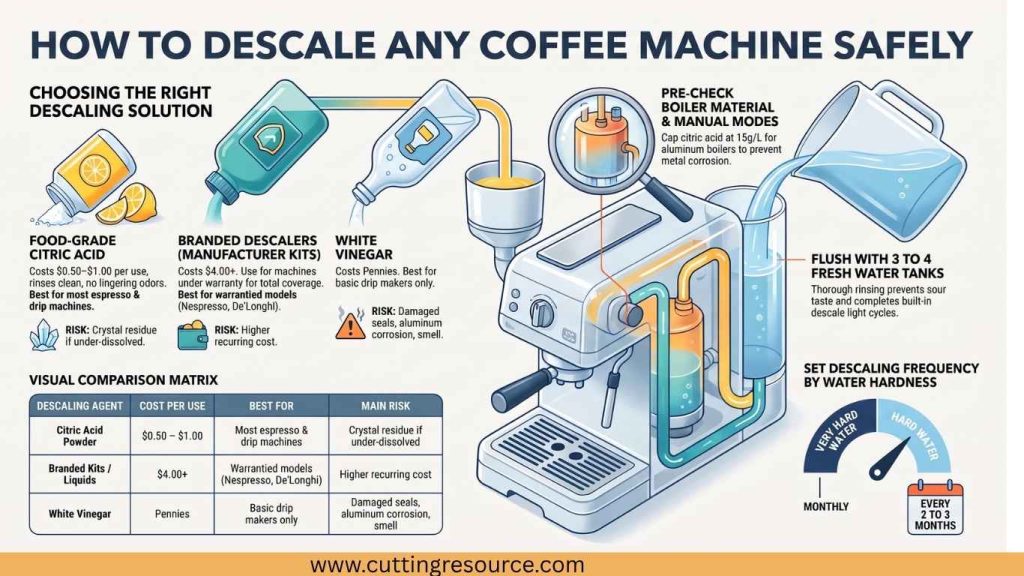
Second, find out what the boiler is made of. Aluminum tolerates acid worse than stainless steel or brass, which is why one citric acid guide caps the dose at 15 g per liter for aluminum boilers. The manual or the manufacturer’s spare-parts page usually lists the material.
Third, read your warranty. Reviewers say Nespresso, Keurig and Jura machines are the ones where an unapproved descaler causes trouble, though I couldn’t find the actual warranty wording on those brands’ sites, so check yours. The opposite risk is real too. De’Longhi’s support page warns that skipping regular descaling can void your warranty.
Then prep the machine. Empty the carafe or tank, remove pods, grounds and paper filters, and pull out any charcoal water filter, because acid saturates the cartridge and taints later brews.
Vinegar, citric acid or branded descaler: which is safe for your machine
Before you descale your coffee machine, pick the agent. The common options cost very different amounts and carry different risks.
| Option | Cost per descale | Best for | Main risk |
| White vinegar | Pennies | Basic drip makers | Lingering smell, hard on rubber seals and aluminum |
| Food-grade citric acid | $0.50 to $1.00 | Most drip and espresso machines | Crystal residue if you under-rinse or overdose |
| Lactic-acid liquid (De’Longhi EcoDecalk) | About 4(19.95 for five doses) | De’Longhi machines | Price |
| Brand kit (Nespresso, Keurig) | Varies by pack | Machines under warranty | Cost, and you’re locked to one brand |
Philips tells owners of its drip makers to use white vinegar at 4% acetic acid, and KitchenAid’s guide accepts it too. Others disagree. Acetic acid attacks aluminum, the smell lingers, and some brands treat it as a warranty problem.
My pick for descaling a coffee maker with no brand requirement is citric acid. It dissolves scale, rinses cleaner than vinegar and costs under a dollar.See food-grade citric acid powder.
To be fair to the other side, De’Longhi claims its lactic-acid formula is gentler on machines than citric acid products. I found no independent test either way, so I treat that as marketing. If your machine is under warranty and the maker names a product, buy that product and keep the receipt.
How much citric acid to use (and why guides disagree)
Published doses don’t agree, and the gap is wide:
- 15 g per liter, about one tablespoon by one reviewer’s measure
- About 20 g per liter, 25 g for hard water, with a 15 g cap for aluminum boilers
- 2 tablespoons per liter
- 20 g in 500 ml, which is 40 g per liter
- A “20 percent solution,” which would be 200 g per liter and looks like an outlier
By my rough conversion that’s a fourfold spread before the outlier. None of the sources explains it. My guess is different boiler materials and different scale loads.
I’d start at 15 g per liter, roughly a level tablespoon, when you descale a coffee maker on a routine schedule. On stainless or brass with heavy scale, 20 g per liter is reasonable. On an aluminum boiler, stay at or below 15 g. If scale survives the first run, repeat the cycle instead of raising the dose.
Dissolve the powder fully in warm water before it goes anywhere near the tank. Crystals that don’t dissolve, or that you under-rinse, leave residue. Use filtered or low-mineral water for mixing so you aren’t adding minerals while you remove mineral buildup.
How to descale a drip coffee maker step by step
Once you know how to descale a drip coffee maker, the job takes 30 to 45 minutes.
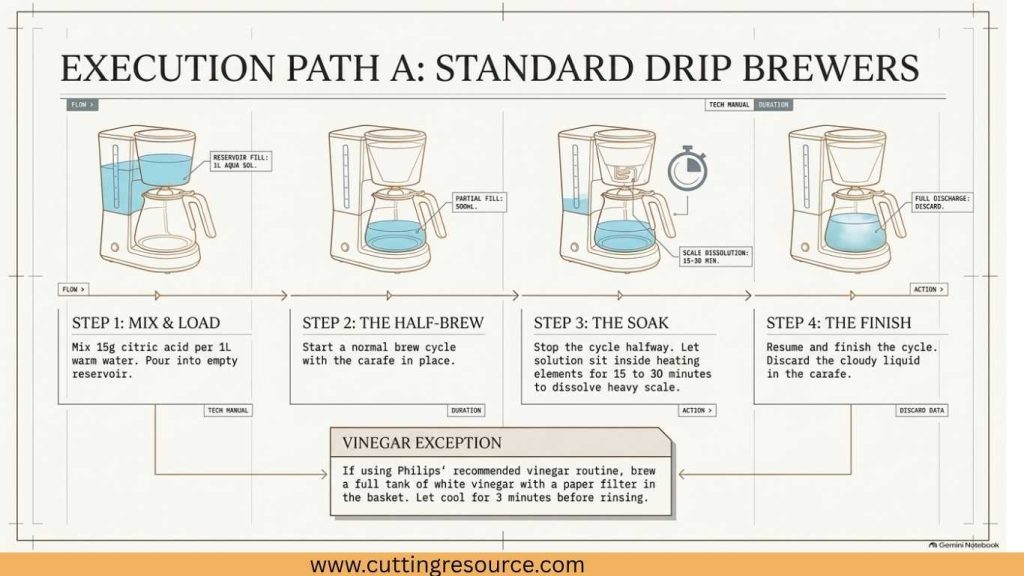
- Empty the carafe, basket and any grounds, and remove the charcoal filter if you have one.
- Mix 15 g of citric acid into 1 liter of warm water, or follow your descaler’s label.
- Pour the solution into the reservoir and start a brew with the carafe in place.
- Stop the cycle halfway and let the solution sit for 15 to 30 minutes. Heavy scale deserves longer.
- Finish the cycle. Cloudy liquid in the carafe is dissolved scale.
- Run three full tanks of fresh water, discarding the carafe each time.
- Wash the carafe, basket and warming plate with soapy water.
If you’d rather use vinegar, Philips has a specific routine. Fill the tank with white vinegar, put a paper filter in the holder to catch loose scale, and brew until the tank is empty. Let the machine cool for three minutes, then flush with fresh water three times. Most other guides dilute the vinegar 1:1, which is gentler on seals. See best affordable drip coffee maker
Descale a Nespresso or Keurig pod machine
Pod machines have narrow passages, and the makers care about the chemistry. When you descale a pod coffee machine, follow your model’s manual over any generic guide, including this one.
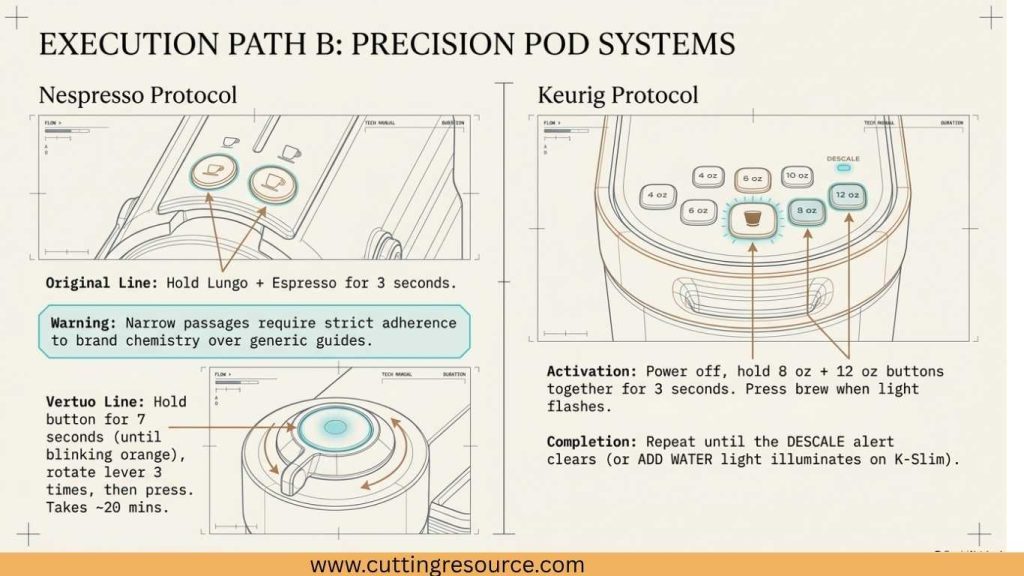
Nespresso Original and Vertuo
Nespresso’s support page routes you by machine type, so confirm yours first. One review site lays out the usual pattern. Empty the capsule container and drip tray, put a 1 liter container under the outlet, and mix one descaling sachet into 0.5 liters of fresh water. On Original Line machines you hold the Lungo and Espresso buttons together for 3 seconds. On Vertuo machines you hold the button for 7 seconds until it blinks orange, rotate the lever three times and press.
The cycle takes about 20 minutes. When the machine prompts you, rinse with a full tank of fresh water.
Keurig
Keurig content recommends descaling every three months, and most models have a reminder light. On models with a descale mode, power off, hold the 8 oz and 12 oz buttons together for 3 seconds, and press brew when the light flashes. Repeat until the DESCALE alert clears or, on the K-Slim, the ADD WATER light comes on.
Remove the charcoal filter first. After the final flush, one guide suggests waiting 30 minutes before rinsing the reservoir and refilling it with fresh water. Button combinations differ by model, so check yours before pressing anything.
How to descale an espresso machine or bean-to-cup model
When you descale a bean-to-cup coffee machine, use the built-in mode if it has one. Breville’s Bambino Plus wants the tank filled to the DESCALE line with the descaler added, and the mode pauses when the solution runs out. The Barista Express heats until the POWER, 1-CUP, CLEAN/DESCALE and HOT WATER/STEAM lights glow solid. You then turn the steam dial right, followed by the hot water dial left.
De’Longhi’s liquid goes in at 100 ml per cycle. A bean-to-cup run takes 20 to 30 minutes, and Coolblue’s guide wants a container of at least 1.5 liters under the spouts. Jura owners should skip vinegar and use Jura’s own tablets, per retailer guidance.
Machines without a descale mode need a manual routine:
- Let the machine cool fully, then empty the tank and drip tray and remove the portafilter.
- Add your solution and put a 1 liter container under the group head and steam wand.
- Run water through in short bursts until about half the solution is gone, then soak for 15 to 20 minutes.
- Flush the steam wand with the remaining solution, since it scales too.
- Rinse twice through both the group head and the wand, wipe the gasket and shower screen, and pull a test shot.
Rinse until the acid is gone
Rinsing is where most attempts to descale a coffee machine go wrong. Leftover citric acid leaves a sour, metallic taste, and one barista guide says it can take eight to twelve espresso pulls to clear. Run at least three full tanks of fresh water through the machine, four if your water is hard.
Check by smell and taste. Philips tells owners to repeat the fresh-water cycle until the water no longer tastes or smells like vinegar, and the same test works for citric acid. If the last tank still tastes sharp, run another.
On machines with a descale mode, don’t cut the final rinse short. The cycle only registers as finished after the last rinse, and that’s the most common reason the light stays on.
Then finish the job. Reinstall the water filter, wash the removable parts, and brew one plain cup to confirm the flavor is back. Descaling won’t touch coffee oils or milk residue, so wash the basket and showerhead by hand and backflush an espresso machine on its usual schedule.
Descale light still on? Here’s how to clear it
After you descale a coffee machine, a stuck light almost always means the machine didn’t count your cycle as finished. De’Longhi says a step was probably skipped or rushed, and its fix is to repeat the descaling process with water only. Fill the tank to the MAX line for the last two rinses.
Fully automatic machines follow the same pattern. Coolblue’s advice is to put a container of at least 1.5 liters under the hot water and coffee spouts, then repeat the final rinse step without descaler. That tells you the machine is counting water volume, not judging how clean it is.
Keurig brewers add a twist. The light stays on until you finish the fresh-water rinse and the brewer leaves descale mode. One guide says holding the 8 oz and 10 oz buttons together for 3 seconds clears it, though combinations vary by model. Clogged needles or a dirty pod holder can also trigger the light.
If it’s still lit after two full runs, stop. Keurig’s guidance, as relayed by one barista blog, is to contact customer service, and the same advice fits any brand.
How often to descale a coffee machine
Descale your coffee machine by water hardness and use, not by the calendar. Defaults vary: Keurig content says every three months, espresso guides say every two to three months, and hard-water advice says monthly. One reviewer’s schedule gives the most useful middle ground.
| Water hardness | Typical range | Descale every |
| Soft | Under 100 ppm | 6 to 12 months |
| Moderately hard | 100 to 200 ppm | 3 to 4 months |
| Hard | 200 to 400 ppm | 2 to 3 months |
| Very hard | Over 400 ppm | Monthly to 6 weeks |
That reviewer suggests tightening one step for pod and espresso machines. Breville counts brews instead of months on the One-Touch CoffeeHouse: every 40 with tap water, every 80 with filtered. A test strip costs under $10 and settles the question.
Your local water supply matters more than your state or region. In the United States, water hardness varies widely by location. Some areas have soft water below 60 mg/L, while others have very hard water above 180 mg/L, especially in regions that rely on groundwater. Test your own tap water before copying anyone else’s descaling schedule.
Descaling mistakes that damage machines
A handful of repeat errors cause most of the damage when people descale a coffee maker at home.
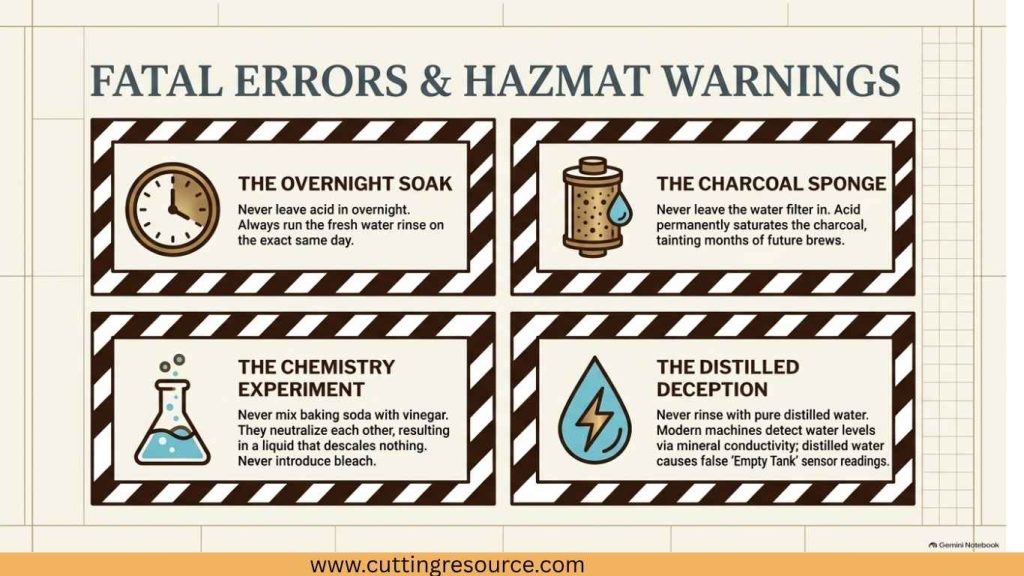
- Leaving acid in overnight. One guide says never to do it. Run the rinse the same day.
- Keeping the water filter in. Acid saturates the charcoal and taints later brews.
- Going undiluted. Straight vinegar or heavy citric acid doses are hardest on aluminum boilers and rubber seals.
- Grabbing bleach or household cleaners. They don’t belong in a coffee machine, and you should never combine them with acid.
- Mixing baking soda with vinegar. The two neutralize each other, so what’s left descales nothing. It’s fine for scrubbing a tank by hand, but not for running through the machine.
- Stopping a descale mode midway. The machine won’t register the cycle, and the light stays on.
- Rinsing with distilled water. Some machines detect the water level through minerals, and distilled water can confuse them.
None of these shows up on day one. Leaks and a struggling pump tend to appear months later, so the two minutes you spend on the manual’s descaling page are cheap insurance.
Frequently asked questions
Can I use vinegar to descale a coffee machine?
Yes, on a basic drip maker. Philips and KitchenAid both say so. Skip it on espresso, pod and aluminum-boiler machines, where seals and warranties are at stake, and run three or four tanks of fresh water afterward to clear the smell.
Does lemon juice work?
It dissolves some scale, but it’s far weaker than commercial descalers, so you’d repeat the cycle several times. Its one advantage is that it smells better than vinegar. Food-grade citric acid gives you the same acid without the mess.
How long does descaling take?
Plan on 30 to 45 minutes to descale a drip coffee maker, about 20 minutes for a Nespresso and 20 to 30 minutes for a bean-to-cup machine’s built-in cycle. Add 15 to 30 minutes if you soak heavy scale.
Does filtered water mean I never need to descale?
No. Filters slow scale but don’t stop it, so you descale less often. Breville’s One-Touch CoffeeHouse interval doubles, from 40 brews on tap water to 80 on filtered water.
What happens if I never descale?
Scale narrows pipes and coats the heating element. You’ll get slower brewing, less coffee per cycle, louder pumps and flat or sour cups, and one reviewer reports brew temperatures 5 to 15 °C below spec. De’Longhi also warns that skipping descaling can void your warranty.
Is descaling the same as cleaning?
No. Acid removes mineral scale, not coffee oils or milk residue. You still wash the basket, showerhead and carafe, and backflush espresso machines on their own schedule.
Summary: how to descale a coffee machine in four decisions
Four decisions cover almost every machine.
- Does the maker name a product? If your machine is under warranty, buy it and follow the manual’s descale mode.
- Does the machine have a built-in cycle? Run it exactly as written, including every rinse.
- No brand rule? Use food-grade citric acid at about 15 g per liter, up to 20 g on stainless or brass with heavy scale, and no more than 15 g on aluminum.
- Basic drip maker on a budget? White vinegar works. Rinse three times and expect the smell to linger.
Finish with three to four full tanks of fresh water, and repeat the final rinse with water only if the light stays on. Then set the next date to descale your coffee machine by hardness: monthly to six weeks above 400 ppm, every two to three months at 200 to 400 ppm, and every three to four months below that.