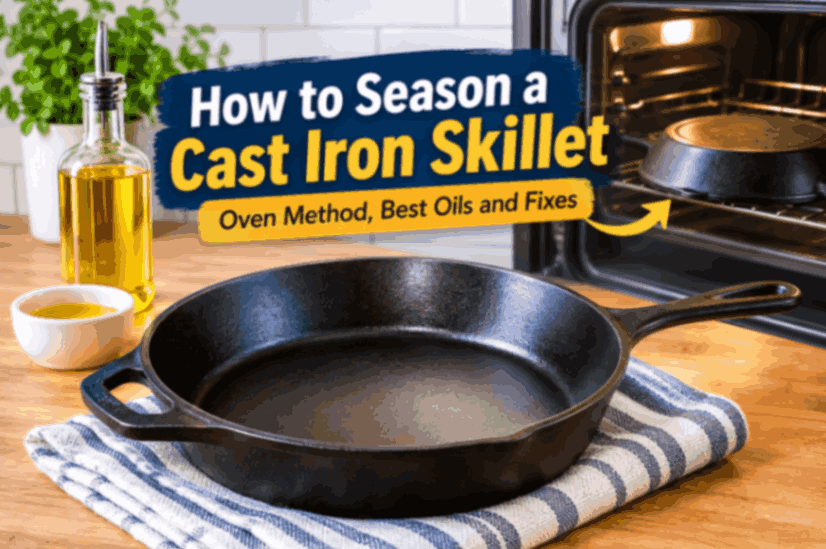
How to season a cast iron skillet: oven method, best oils and fixes
Lodge bakes soybean oil onto every skillet before it leaves the foundry. So why does your pan still grab eggs? That factory layer is thin, and bare, vintage or stripped pans have none at all.
To season a cast iron skillet, wash and dry it, wipe on oil until the pan looks almost dry, and bake it upside down at 450 to 500°F for one hour. Let it cool in the oven. Repeat two or three times on a bare pan, or once to refresh a dull one.
Key Takeaways
- Pre-seasoned pans from Lodge or Field can go straight to the stove. Bare, vintage and stripped pans need oven seasoning.
- Grapeseed, canola or vegetable oil all work, as long as you wipe the pan until almost no oil is left.
- Bake upside down at 450 to 500°F (230 to 260°C) for one hour, then cool the pan inside the oven.
- A bare pan needs two or three rounds. A worn pan needs one.
- A sticky surface almost always means too much oil, and the fix is another hot bake.
- Re-season when food sticks, the surface looks dull or rust appears, not on a fixed calendar.
How to season a cast iron skillet (and when you can skip it)
Before you season a cast iron skillet, find out what kind of pan you own. Check the table, then jump to the section you need.
| Your pan | Season it? | What to do |
| Pre-seasoned (Lodge, Field, most modern pans) | Optional | Wash, dry, and cook with extra oil for the first few meals |
| Bare or unseasoned | Yes | Oven-season, 2 to 3 rounds |
| Vintage (Griswold, Wagner) | Usually | Clean off flaking or rust, then 2 to 3 rounds |
| Rusty or stripped | Yes | Remove rust first, then 2 to 3 rounds |
| Enameled (Le Creuset, Staub) | Never | The enamel coating already protects the iron |
A Lodge cast iron skillet beside an enameled Dutch oven on a kitchen counter, showing which pan types need seasoning
Factory seasoning is a thin start. Lodge says its pans are ready to cook in right out of the box. Field Company agrees that oven seasoning is optional, though it admits bacon and eggs may stick early on. Ooni goes the other way and tells owners to re-season before the first cook.
If you plan to fry eggs or flip pancakes in week one, a single round at home is cheap insurance. It costs about a teaspoon of oil and two hours, most of them unattended. Shopping for a first pan? best cast iron skillets
Best oil to season a cast iron skillet
Pick a neutral oil with a smoke point near 400°F or higher, then bake it past that point. Heat breaks the oil down, and the pieces link into a hard coating bonded to the iron. Food scientist Harold McGee, cited in The Kitchn’s oil test, says oils high in unsaturated fat do this best. That’s why bacon grease, lard and coconut oil rank lower.
| Oil | Approx. smoke point | Verdict |
| Grapeseed | 420°F | Best all-rounder; won The Kitchn’s five-oil test |
| Canola or vegetable | 400°F | Lodge’s pick; cheap and easy to find |
| Refined avocado | 500°F | Handles high heat but costs more |
| Crisco shortening | 490°F | Cheap and reliable; melt it before wiping on |
| Flaxseed | Low | Dark finish, yet it ran over $1 an ounce in Kitchn’s test and some users report flaking |
| Extra virgin olive | 350 to 400°F | Smokes before it bonds; skip it |
| Beef tallow or lard | About 400°F | Great for cooking; can turn rancid on a stored pan |
For most people, grapeseed is the easy answer. A 68-ounce bottle ran about $14 when Kitchn tested it, and you’ll use it for cooking too. Pompeian grapeseed oil, 68 oz is the bottle they used. Prefer a spray? Lodge Seasoning Spray is plain canola oil at roughly $12 for eight ounces, though you still have to wipe off the excess.
Avoiding seed oils? Refined avocado oil is the closest high-heat swap. Lodge guide to oils for cooking and seasoning
Seasoning cast iron in the oven: temperature, time and steps
Guides quote anything from 350 to 500°F, and the reason is simple. When you season a cast iron skillet in the oven, the oven has to push the pan just past the oil’s smoke point. America’s Test Kitchen uses 500°F. Lodge says 450 to 500°F. Field Company bakes at 400°F with its own oil. For grapeseed, canola or vegetable oil, 450°F (230°C) is a safe middle.
- Wash. Scrub with warm, soapy water and a stiff brush to remove factory residue or old gunk. Soap is fine here because you’re about to rebuild the surface.
- Dry. Towel it off, then set the pan on a hot burner for two minutes until every drop is gone.
- Oil. Rub oil over the whole pan, inside, outside and handle, with a lint-free cloth. Then buff with a clean towel until it looks almost dry. About one teaspoon covers a 10 to 12 inch skillet.
- Prep the oven. Lay foil on the lower rack to catch drips and preheat to 450°F.
- Bake. Set the skillet upside down on the middle rack for one hour.
- Cool. Turn off the heat and leave the pan inside until it’s cool enough to handle. Lodge says this helps the layer bond to the iron.
- Repeat. Run steps 3 to 6 two more times on a bare pan. America’s Test Kitchen goes as high as five coats.
Hand buffing a thin layer of grapeseed oil onto a cast iron skillet with a paper towel
Each round takes roughly two hours with preheating and cooling, but you’re only busy for about five minutes. Lodge seasoning guide
How to season cast iron on the stovetop or grill
No oven, or just touching up a pan that looks dry? You can season a cast iron skillet on the stovetop in about 15 minutes. Gear Patrol’s method, backed by Smithey Ironware and chefs like J. Kenji López-Alt, goes like this.
- Open a window and turn the range hood to high. This method smokes.
- Wipe a thin coat of oil over the pan, then wipe again until it looks near-matte. A glossy pan means too much oil.
- Set the skillet on a burner at high heat. Within three to five minutes you’ll see wisps of smoke. That’s the oil breaking down.
- When the surface looks bone dry, wipe on another whisper of oil with the same rag. Two extra layers is plenty.
- Turn off the burner and let the pan cool on its own.
The trade-off is coverage. Stovetop seasoning tends to be less even than an oven bake, and it mostly treats the cooking surface, not the outside of the pan. Use it for refreshes, not for a brand-new bare skillet.
A gas grill works like an oven and keeps the smoke outdoors. Mr Cast Iron seasons some pieces that way. Preheat to about 450°F, set the oiled pan upside down on the grate, close the lid, and give it an hour.
How to tell if your seasoning worked
Skip the guessing. After you season a cast iron skillet, three quick checks show where the pan stands.
- Look. A good coat is dark, smooth and satin, not wet-looking or glossy. Patchy brown spots after round one are normal. Lodge says early layers can be uneven and will interlock as you cook.
- Touch. Run a clean finger over it. The surface should feel dry and slick, never tacky.
- Fry an egg. America’s Test Kitchen’s test: heat one tablespoon of vegetable oil over medium heat for three minutes, then add an egg. In a well-seasoned pan it shouldn’t stick much.
A fried egg sliding cleanly across a dark, seasoned cast iron skillet
Keep expectations realistic. Kitchn’s tester saw mottled coats from grapeseed and canola at first, and the color evened out after a few rounds. Field Company warns that bacon and eggs can stick early in a pan’s life.
Cook fatty foods first: sausage, bacon, chicken thighs or a tray of home fries. Each one lays down another thin layer. Dark residue on your towel during the first weeks is normal too, according to Lodge, and it fades with use.
Sticky, flaking or splotchy seasoning: causes and fixes
Most seasoning problems trace back to oil, heat or timing. This table covers the common ones.
| Problem | Likely cause | Fix |
| Sticky or tacky | Too much oil, or not enough heat | Scrub the sticky spots with coarse salt, then bake the empty pan upside down at 450°F for an hour |
| Flaking black bits | Layers never bonded; flaxseed oil; acidic food too early | Scrub with a nylon brush or salt, rinse, dry, oil, then do 2 to 3 oven rounds |
| Splotchy or mottled | Uneven oil or heat | Mostly cosmetic; keep cooking, or bake once more |
| Dull, gray or matte | Worn seasoning | Cook with fat, or oven-season once |
| Dark smear on towel | Fresh seasoning working loose | Normal, according to Lodge; it fades with use |
The most common culprit by far is too much oil. In r/castiron’s help threads, pooled or sticky oil shows up again and again. If you can see a sheen before the pan goes in, wipe it again. A properly thin coat polymerizes fully, so nothing is left behind to stay gummy.
Acidic foods also strip fresh seasoning. Lodge says to wait until a base layer is built, then keep tomato sauce or lemon-heavy dishes under about 45 minutes.
Seasoning a rusty or vintage skillet: strip it first
Never season a cast iron skillet over rust. Remove it first, or the new layer sits on a weak base and flakes.
- Scrub the rust with a stainless steel scrubber. Wirecutter uses a slurry of Bar Keepers Friend and a couple of tablespoons of water for heavy rust.
- Rinse well. A short vinegar soak also works, but check it often and don’t leave the pan overnight, since long soaks eat into the metal.
- Wash and dry the pan completely, then put it on a burner for a minute. Flash rust can form within minutes on wet bare iron.
- Oil it right away and run two or three oven rounds, as Field Company recommends after stripping.
Thick, crusty old seasoning that’s flaking in sheets also needs stripping, using the same scrub-and-rinse approach. Pebbly modern skillets sometimes feel rough. Lodge says fine-grade sandpaper can smooth them, as long as you re-season promptly afterward. Vintage pans from Griswold or Wagner are usually machine-smoothed already, so they rarely need it. how to restore rusty cast iron.
How often should you season a cast iron skillet?
Calendar advice is all over the place. Lodge suggests oven-seasoning a few times a year. Tom’s Guide says two or three times. Daily Meal says monthly. A weekend cook and a daily cook wear down a pan at very different speeds, so go by symptoms instead.
Re-season in the oven when you see any of these signs:
- Food sticks more than it used to
- The surface turns dull or gray
- A rust spot appears
- You’ve just stripped the pan
Between oven rounds, daily habits do most of the work. Dry the pan on a burner after washing. Rub in a few drops of oil while it’s warm. Cook with fat often, because each fried egg or seared steak adds a thin layer. A metal spatula with a straight edge helps smooth the surface over time.
Soap is fine for regular cleaning. Skip long soaks and the dishwasher, since standing water is what brings rust back. If you cook acidic dishes often, expect to touch up the seasoning a little sooner. how to clean cast iron without ruining the seasoning.
Safety: smoke, hot pans and pet birds
Seasoning heats oil past its smoke point on purpose, so plan for smoke, heat and a few surprises before you start.
- Ventilate. Run the hood fan and open a window. Keep the smoke alarm connected, and fan the air if it chirps.
- Protect birds. Appliance manuals, including Maytag’s, warn that fumes from overheated cooking oil and fat can harm pet birds. Move birds to a far room with the door closed, or season on a grill outside.
- Avoid thermal shock. Never run cold water over a very hot skillet. Gear Patrol warns it can crack the iron.
- Check the handle. Wooden handles can’t go in a 450°F oven. Use the stovetop method instead.
- Catch drips. Foil on the lower rack protects your oven. If oil drips off, you used too much.
Range hood running above a skillet seasoning on the stove with a kitchen window open
Treat the pan like a 450°F baking sheet for the next hour. Mitts on, handle clear, and keep kids and pets out of the kitchen until the pan has cooled all the way down. A cast iron skillet holds heat for a long time after the oven shuts off.
Summary: the seasoning decision guide
Whenever you need to season a cast iron skillet, use this checklist and you’ll never wonder what comes next.
- Check the pan. Pre-seasoned means optional. Bare, vintage or stripped means season it. Enameled means never.
- Choose the oil. Grapeseed, canola or vegetable oil. Skip extra virgin olive oil, and treat flaxseed and tallow as optional extras.
- Bake it. Wipe until almost dry, then go upside down at 450 to 500°F for one hour, with foil below. Cool in the oven.
- Repeat. Two or three rounds for a bare pan, one for a refresh.
- Test it. Look for a dark satin finish, then fry an egg in a tablespoon of oil.
- Troubleshoot. Sticky means too much oil. Flaking means scrub and re-season. Rust means strip first.
- Maintain. Dry on a burner, rub in a few drops of oil, and cook with fat. Re-season when symptoms show, not by the calendar.
Follow that order and a $30 skillet will outlast most of your kitchen.
Frequently asked questions
Can you season a cast iron skillet with olive oil?
Extra virgin olive oil smokes at roughly 350 to 400°F and tends to give a patchy coat, so it’s a poor pick. Refined olive oil handles heat a bit better but still ranks below grapeseed or canola.
How long does it take to season a cast iron skillet?
One oven round is an hour of baking plus preheating and cooling, so plan on about two hours. A bare pan needs two or three rounds. A stovetop touch-up takes around 15 minutes.
Do you need to season a new pre-seasoned skillet?
Not before the first cook. Lodge says its pans are ready to use, and Field Company calls oven seasoning optional. Wash, dry and cook with plenty of oil. Oven-season later if food sticks.
Is it okay to use soap on seasoned cast iron?
Yes. Modern dish soap won’t strip a properly baked layer, and Lodge’s own steps start with warm, soapy water. Skip long soaks and the dishwasher, then dry the pan on a burner.
What temperature should you season cast iron at?
Use 450 to 500°F for most oils. Lodge recommends that range, and America’s Test Kitchen uses 500°F. Lower settings like 350 or 400°F can work, but the oil cures less thoroughly, so give it the full hour or longer.
Can you season cast iron with butter, bacon grease or tallow?
Butter burns well below seasoning temperatures, so save it for cooking. Bacon grease, lard and tallow build seasoning slowly as you cook with them, but they can go rancid on a pan that sits unused. Use a neutral oil for the oven rounds.