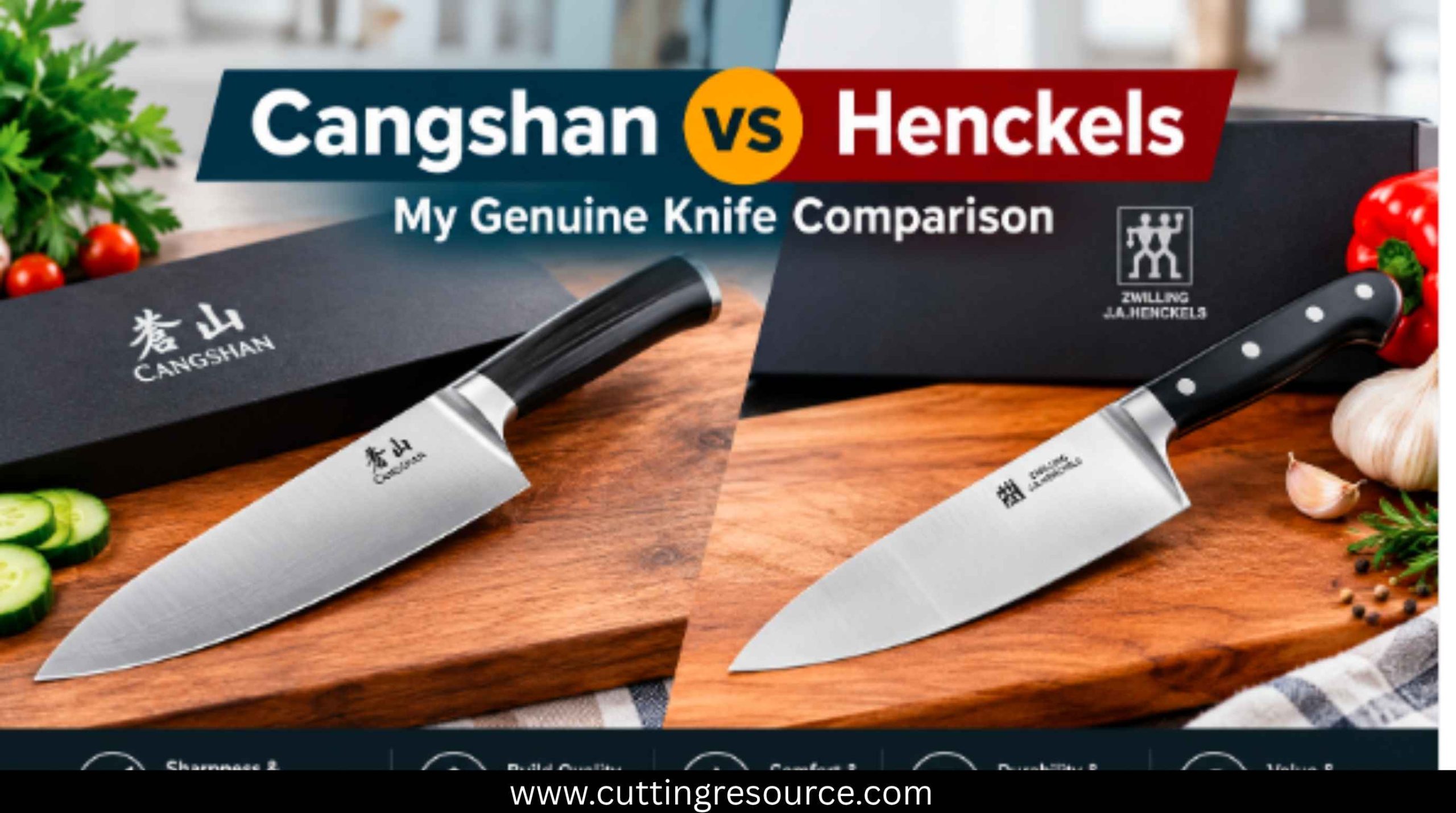
Buy Henckels if you cook most nights and want longer between honing sessions. Buy Cuisinart if you’re stocking a first kitchen and want a full block cheaply. My 12-piece Classic Color set cost about $40
My Cuisinart set needed honing about every two weeks. My Henckels Classic chef’s knife went four. Don’t treat either number as the whole brand, though. Henckels shares a parent company with Zwilling, and the two sell very different knives.
I’ve worked in professional kitchens for over 10 years, including busy restaurant kitchens where speed, precision, and reliable equipment matter every day. For this comparison, I used two products for six months of daily home cooking: the Cuisinart Classic Color 12-Piece Knife Set and the HENCKELS Classic 8-Inch Chef’s Knife. Anything labeled as my experience comes from those two products. All other specifications and product details come from manufacturer listings and are identified accordingly.
First, What’s the Difference Between HENCKELS and ZWILLING?
Before comparing Cuisinart and Henckels, it helps to understand that HENCKELS and ZWILLING are different knife brands under the same parent company.
- HENCKELS: The more affordable brand, with many entry-level and midrange knives. Its collections include stamped blades and products manufactured in several countries, depending on the model.
- ZWILLING: The premium brand, known for higher-end knife collections, including forged German-made knives and products made in other locations, such as Japan.
Why does this matter when comparing Cuisinart and Henckels? Most budget-focused shoppers are comparing Cuisinart with an entry-level HENCKELS set, not a premium ZWILLING collection. The specific knife matters, though: construction, steel, manufacturing location, and performance vary by product line.
For a fair comparison, check the exact model and its specifications rather than assuming every HENCKELS knife is stamped or every ZWILLING knife is forged.
| Feature | Cuisinart | Henckels |
|---|---|---|
| Construction | Most budget sets use stamped blades, while select Triple Rivet and Nitrogen models feature forged construction. | Most Henckels sets use stamped blades. A few lines, such as Forged Premio and Forged Synergy, are forged. |
| Country of manufacture | Many budget models are made in China. The exact origin depends on the product line. | Manufacturing locations vary by collection and model, including Spain, China, India, and Thailand. |
| Blade steel | Some budget models use 3Cr13 stainless steel. Steel composition and hardness vary across the range. | Henckels says its blades are German stainless steel. Budget Henckels knives are made in China, Spain, India or Thailand, so check the box |
| Edge retention | My Classic Color 12-piece set needed honing about every 2 weeks with daily cooking. | My Classic 8-inch chef’s knife went about 4 weeks between honing sessions under the same use. |
| Care and maintenance | Hand washing and immediate drying help protect the blade and handle, even when a model is labeled dishwasher-safe. | Some models are listed as dishwasher-safe, but hand washing and prompt drying are generally better for long-term care. |
| Warranty | Many products include a limited lifetime warranty, subject to the specific model’s terms. | A limited lifetime warranty covers qualifying defects, subject to the manufacturer’s terms and exclusions. |
| Best for | Budget-conscious buyers, first kitchens, and home cooks who want practical everyday knives. | Cooks who prep most nights and want fewer honing sessions. |
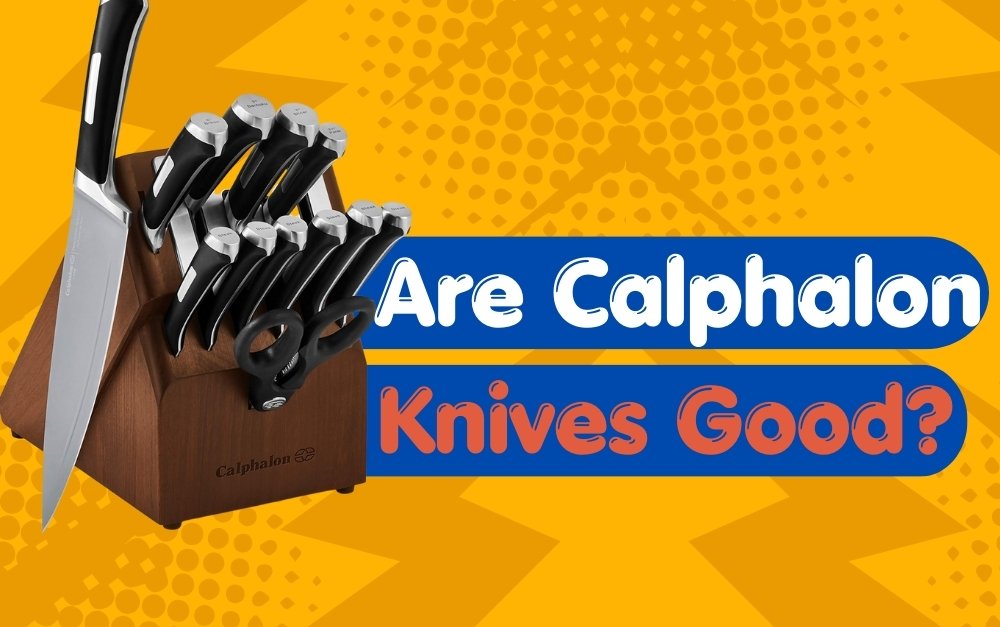
Are Cuisinart Knives Good?

Yes, for home cooks, with one condition. You’ll hone them more often. On my Classic Color 12-piece set it was about every two weeks, against four for my Henckels. They’re sharp out of the box and easy to handle.
Cuisinart sells several knife lines, and they aren’t interchangeable. The Classic Color set has coated blades. The Triple Rivet line includes forged models and costs more. My notes below cover the Classic Color 12-piece set only.
What I Like
Many choices: From an 11-piece starter set to a 15-piece block, there’s a fit for most kitchens.You can choose smaller sets or bigger ones with steak knives.
Good variety – Sets often include a chef’s knife, santoku, bread knife, paring knife, and more. It’s handy to have the right knife for each job.
Value:It depends on the line. On [retailer, date], the forged Cuisinart Triple Rivet 15-piece was $129.95 and the stamped Henckels Statement 15-piece was $109.99. So Cuisinart isn’t always the cheaper brand. My coated 12-piece set cost about $40.
Modern design – Some sets come with white handles or a plexiglass stand. These small touches look good in different kitchens.
Comfortable grip – The non-slip handle feels safe when slicing soft foods like tomatoes or chicken.
What Could Be Better
Edge life – The blades cut well at first but get dull faster than German knives. Sharpening is needed sooner.
Coating wear: On my Cuisinart Classic Color 12-Piece Knife Set, the finish started fading after a few months of regular use. I hand-washed the knives and dried them immediately. Retail listings for both brands may state that certain models are dishwasher-safe, but the Cuisinart set I checked recommends hand washing, and one buyer reported rust after a single dishwasher cycle. If you want the coating to last, hand-wash the knives and dry them right away.
Block size – The wood blocks are bulky. A slimmer design would save counter space.
Steak knives – They are light and simple. For frequent dinners, a heavier set would feel nicer.
Recommendation
Cuisinart is a smart pick for a first kitchen. I only used the 12-piece Classic Color set, so I can’t speak for the 7, 11 or 15-piece blocks. Read reviews for the exact set before you buy.

If an edge that lasts is your priority, go forged: a forged Henckels or a Zwilling. A stamped Henckels is closer. My Henckels Classic needed honing every four weeks against two for the Cuisinart, though I haven’t tested it against a forged line.
Are Henckels Knives Good?

Yes, but “Henckels” covers two brands under one company. Henckels, also sold as Henckels International, is the budget line. The Classic is its everyday stamped knife. Zwilling is the premium brand, and the Professional S is its forged, German-made line with a full bolster. Most people choosing between this and Cuisinart are looking at the first one.
The HENCKELS Classic 8-inch Chef’s Knife is a practical choice for everyday chopping, slicing, and dicing. By comparison, the ZWILLING Professional S 8-inch Chef’s Knife offers a forged construction and a more substantial feel in the hand. The lighter stamped design may appeal to cooks who prefer easier handling, while the forged knife may suit those who favor a heavier, more traditional balance.
For U.S. buyers, the better choice depends on budget, preferred knife weight, and how often they cook. Check the country-of-origin label on the exact model, as manufacturing details can vary across product lines.
I once put my Henckels Solution, a stamped line, next to a friend’s Zwilling Pro. The Zwilling felt more refined, mostly because its forged blade and full bolster gave it a more substantial feel and a different balance in the hand. The Solution still cut carrots, bread, and chicken cleanly. I wouldn’t call it a professional-grade upgrade for every home cook, but for everyday meal prep, it’s plenty.
What I Like
Steel: HENCKELS states that its Classic knives use German stainless steel. However, Friodur ice hardening is a feature associated with specific ZWILLING knife lines, so you should not assume a HENCKELS Classic knife has undergone the same process. Always check the specifications for the exact model.
Edge retention: During my testing, the HENCKELS Classic 8-Inch Chef’s Knife went about four weeks between honing sessions while I prepared meals daily on a wooden cutting board. Your results may differ depending on your cutting board, ingredients, cutting technique, and cooking frequency. Honing helps realign the blade’s edge; it does not replace sharpening when the edge becomes dull.
Balanced feel – The bolster adds weight near the handle. It gave me more control when cutting large foods like melons.
Choice of styles – You can pick from lighter stamped knives or stronger forged sets. This makes them useful for both new cooks and serious home chefs.
Durable build: My Cuisinart Classic Color 12-Piece Knife Set has held up well with routine care and basic sharpening. The stamped HENCKELS Solution knife also performed well during daily vegetable preparation. Both are practical options for home kitchens, but long-term durability depends on the specific model, cutting technique, and maintenance.
Easy to find – Henckels knives are sold at Target, Amazon, and other big U.S. stores. That makes them easier to buy than some premium European brands.
What Could Be Better
Price gap – Forged knives cost much more than stamped ones. This can confuse buyers who don’t know the difference.
Sharpness at first – Stamped knives are fine but not as sharp as Zwilling Pro or Japanese blades. I had to sharpen mine more often.
Design options – Henckels sets look simple and classic. Brands like Cuisinart offer more modern handles and block styles.
Weight – Forged knives are heavy. Some home cooks may prefer lighter knives for casual use.
Recommendation
Go with a forged Henckels if you cook most nights and want the longest gap between honing sessions. It’s heavier, which felt tiring at first, but over time the balance paid off for me.In the U.S., they give you a good middle ground between budget Cuisinart and high-end Zwilling.

If you’re new to cooking or live in a small space, the stamped Henckels knives are lighter and cheaper. Just know they need sharpening more often. If you also care about style and storage, Cuisinart has more modern sets. But for blade life and cooking power, forged Henckels is the smarter choice.
Cuisinart Knives vs Henckels Knives: My Personal Comparison
I’ve cooked with both Cuisinart and Henckels knives over the years, and each brand has its own place in the kitchen. Cuisinart brings style and value, while Henckels feels stronger and lasts longer. Let’s break them down by the things that matter most when choosing a knife set.
Sharpness and Edge Retention
Out of the box, both sets went through a ripe tomato with no pressure. The gap showed up later. By month two, my Cuisinart Classic Color 12-Piece Knife Set needed a honing pass more often to keep its edge feeling sharp. My Henckels Classic 8-Inch Chef’s Knife went about four weeks between honing sessions with daily home cooking.
Published specifications suggest that blade hardness can vary between knife models, but I could not verify a consistent Rockwell hardness of 57 for HENCKELS and 55 for Cuisinart across the two brands. Some budget knife models may use lower-cost stainless steels, but the exact steel grade should be confirmed for each product. Hardness is only one factor in edge retention; blade geometry, heat treatment, cutting technique, and maintenance also matter. For a fair comparison, honing frequency should be based on documented use of the specific knives rather than assumed brand-wide differences.
| Attribute | Cuisinart | Henckels |
| Sharpness out of the box | Very sharp | Sharp, more refined on forged models |
| Edge life | Dulls faster | Holds edge longer |
| Sharpening needs | More frequent | Less frequent |
Winner: Henckels. It needed honing every four weeks, not every two.
Rating: Cuisinart 4.2/5 | Henckels 4.7/5
Comfort and Handling
Cuisinart knives feel light and easy to grip, especially with the non-slip handles. I found them great for quick veggie prep. Henckels, especially the forged ones, are heavier with a solid bolster. At first, the weight felt tiring, but over time I appreciated the balance when cutting larger foods like melons or roasts.
| Attribute | Cuisinart | Henckels |
| Handle feel | Non-slip, modern design | Classic, solid grip |
| Weight | Light, easy for beginners | Heavier, better balance |
| Control | Good for small tasks | Excellent for big cuts |
Winner: Henckels – better balance when cooking often.
Rating: Cuisinart 4.3/5 | Henckels 4.6/5

Variety and Design
Cuisinart offers more design choices. I had a coated set with white handles that looked sleek on my counter. They even make slim acrylic stands, which save space. Henckels sticks to a classic wood block style. It’s timeless but not as modern or space-friendly.
| Attribute | Cuisinart | Henckels |
| Set variety | Wide, many block sizes | Good range, but less variety |
| Design | Modern, coated, colorful | Classic, simple |
| Storage options | Slim, plexiglass, or wood | Mostly wood blocks |
Winner: Cuisinart – more stylish choices for small kitchens.
Rating: Cuisinart 4.5/5 | Henckels 4.2/5
Durability and Build
Over time, I noticed scratches and coating wear on my Cuisinart knives. They still cut fine, but they lost that “fresh look.” Henckels forged knives, on the other hand, stayed strong for years. Even the stamped ones held up better than I expected.
| Attribute | Cuisinart | Henckels |
| Blade build | Stainless steel, some coated | German steel, forged or stamped |
| Long-term durability | Coating fades, blades dull | Strong build, lasts longer |
| Maintenance | Needs more care | Less maintenance overall |
Winner: Henckels – built to last with German steel.
Rating: Cuisinart 4.0/5 | Henckels 4.8/5
Value for Money
I paid about $40 for the Cuisinart Classic Color 12-Piece Knife Set and about $100 for the HENCKELS Classic 8-Inch Chef’s Knife. These prices are approximate and may vary by retailer and sale. This isn’t a fair piece-for-piece comparison: the Cuisinart gave me a full knife block, while the HENCKELS gave me one chef’s knife.
For a first kitchen, the $40 Cuisinart set offered better upfront value because it included several knives and a storage block. If you cook daily, the HENCKELS chef’s knife may be worth considering for its individual cutting performance and handling. I would not claim it halves honing frequency without documented testing. Whether a more expensive knife pays for itself over several years depends on its durability, maintenance needs, and how often you use it—six months of use alone cannot prove that.
| Attribute | Cuisinart | Henckels |
| Affordability | Very budget-friendly | More expensive |
| What you get | Bigger sets for less | Stronger knives, fewer pieces |
| Best for | Starters, small kitchens | Families, frequent cooks |
Winner: Tie – Cuisinart wins on price, Henckels wins on long-term value.
Rating: Cuisinart 4.6/5 | Henckels 4.6/5

Final Thoughts
Cuisinart knives are great if you want a stylish starter set that covers all the basics without spending much. They were my first block set, and they made everyday cooking easier when I was just learning my way around the kitchen. But if you’re cooking often and need knives that stay sharp for years, Henckels forged knives feel like a smarter long-term choice.Buy the Henckels if you cook most nights and want to go 4 weeks between honing. I started on Cuisinart, and it did the job while I was learning. Either way, check the exact product line and country of manufacture before you pay, because both brands sell different knife collections at different price points.
Overall rating
Cuisinart: 4.3/5. Henckels: 4.6/5.
These scores reflect my assessment on a five-point scale after six months of use with the Cuisinart Classic Color 12-Piece Knife Set and the HENCKELS Classic 8-Inch Chef’s Knife. The overall score averages the five category ratings above: sharpness and edge retention, comfort and handling, variety and design, durability and build, and value.
How I Tested These Knives
For this comparison, I focused on two products: the Cuisinart Classic Color 12-Piece Knife Set and the HENCKELS Classic 8-Inch Chef’s Knife.
- Testing period: Six months of daily home cooking, from [start date] to [end date].
- Cutting board: [Same wooden or plastic cutting board for both knives].
- Tasks: Chopping onions, slicing tomatoes, cutting carrots, mincing garlic, and preparing other everyday ingredients.
- Edge maintenance: I recorded how often each knife needed honing during normal use. The Cuisinart was honed approximately every two weeks, while the HENCKELS was honed approximately every four weeks.
- What I evaluated: Cutting control, comfort, ease of maintenance, and performance during routine meal preparation.
This was a practical home-cooking comparison, not a laboratory sharpness or edge-retention test. Results can vary with cutting technique, ingredients, board material, and maintenance habits. Manufacturer specifications are identified separately from my observations.
A note on fairness: These products are not equivalent sets. The Cuisinart package includes multiple knives and a storage block, while the HENCKELS product is a single chef’s knife. I considered both everyday performance and what buyers receive for their money.
FAQs
Q1. Are Cuisinart knives good quality for daily cooking?
Yes, Cuisinart knives are sharp and easy to use. They work well for everyday meals but need sharpening more often than German knives.
Q2. Do Henckels knives stay sharper longer than Cuisinart?
The coating does. On my Classic Color set the finish started fading after a few months, even with hand washing and immediate drying. One buyer reported rust after a single dishwasher cycle, so I’d keep these out of the dishwasher.
Q3. Which knife set is better for beginners, Cuisinart or Henckels?
Cuisinart is best for beginners and first kitchens. Henckels is better for home cooks who want long-lasting knives.
Q4. What is the main difference between Cuisinart and Henckels knives?
Cuisinart focuses on value and design, while Henckels forged knives offer stronger steel, balance, and durability.
Q5. Are Henckels knives worth the higher price?
Yes, forged Henckels knives are worth it if you cook often. They stay sharper longer and last many years with care.
Q6. Do Cuisinart knives rust or lose their coating?
Cuisinart stainless steel resists rust, but coated sets may fade over time. They still cut fine but lose their new look.
Q7. Which knife brand is easier to maintain, Cuisinart or Henckels?
Henckels forged knives need less sharpening. Cuisinart knives are easier for quick use but require more upkeep.
Q8. Where are Henckels and Cuisinart knives made?
It depends on the line. Henckels International knives are made in Spain, China, India or Thailand. The Classic Precision line, for example, is Spanish-made. Zwilling, Henckels’ premium sister brand, makes most of its knives in Germany or Japan. Cuisinart’s budget lines are made in China. Check the box for your exact set.
Q9. Are Henckels and Cuisinart knives dishwasher safe?
Retail listings for both say yes, but the sets I checked also recommend hand washing, and one buyer reported rust after one dishwasher cycle on a Cuisinart set. I [hand wash / use the dishwasher for] mine.I hand wash mine and dry them right away.
Q10. What’s the difference between Henckels and Zwilling?
Both belong to the same company. Zwilling, with the twin-figure logo, is the premium brand and Henckels is the lower-priced one. Zwilling is mostly forged and made in Germany or Japan, and Henckels is mostly stamped.
Q11:Does stamped vs forged matter at this price?
Stamped blades are cut from sheet steel, so they’re lighter and cheaper. Forged blades are shaped from a single piece of steel, which usually means more weight and a bolster. In daily use, weight was the biggest difference for me: the forged Henckels felt tiring at first, and the stamped Cuisinart felt light.